Cobblestone is the block every build eats by the thousand, and it is the easiest thing in Minecraft to make infinite. When flowing lava meets water, the spot where they touch turns into cobblestone. Mine it, and the fluids touch again and make another one. That is the whole farm: a generator you can stand at forever, or wire to pistons so it fills a line of blocks for you.
This guide is part of our Minecraft farm guides for 26.3.
RateAs fast as you can mine
XP levelNone
Build time2-5 min
DifficultyBeginner
Checked for: Minecraft 26.3, Java Edition. Lava and water generators work in the Overworld and the End; in the Nether, water evaporates, so build them elsewhere.
Quick answers
- What makes cobblestone? Flowing lava touching water. The block where they meet becomes cobblestone.
- Why did mine make obsidian? Water reached the lava source block. Flowing water touching a lava source turns it into obsidian.
- Stone instead of cobblestone? Lava has to flow into water from above; that needs a piston design.
- Basalt? Lava, blue ice and soul soil, no water at all.
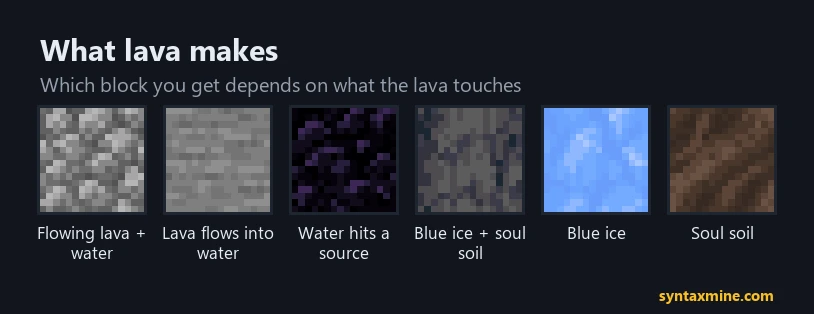 Image: SyntaxMine, made from Minecraft's own textures.
The basic generator that never makes obsidian
The simplest reliable layout is a short trench:
- Dig a trench five blocks long, one block deep.
- Dig one block deeper in the middle square. This hole is where the cobblestone forms.
- Pour water into one end of the trench.
- Pour lava into the other end.
- The water flows toward the hole, the lava flows toward the hole, and where they meet you get cobblestone.
The rule that keeps it working: water must never reach the lava source. If it does, the source becomes obsidian and the generator stops. Two easy safeguards:
- Make the water side long enough that it stops before the lava.
- Put a stair in the water source block, flat side toward the lava. Water still flows out of it, but it cannot spread over the lava source.
Cover the lava with a non-flammable block (cobblestone works) so the cobblestone you mine does not fall in and burn, and so you do not fall in either.
Making it faster to mine
The generator itself is instant: the moment you break the block, a new one forms. The limit is you.
- Efficiency V on a diamond or netherite pickaxe.
- Haste II from a beacon makes the difference between chipping and flicking through blocks.
- Unbreaking III and Mending so the pickaxe repairs from the XP you are earning elsewhere.
- Mining stone is slightly faster than mining cobblestone, one reason to build a stone generator later.
Piston generators: let the farm push for you
A piston in front of the forming spot pushes each new block out of the way, so the fluids can touch again and the next block forms behind it. Driven by a redstone clock or a block detector, it keeps pushing until there is a line of blocks to mine all at once.
- A single piston can push at most 12 blocks, so the line tops out around 13 blocks before you need to clear it.
- Extra pistons push the line sideways or upward for longer runs.
- Designs that push up into a wall of blocks let you tunnel-mine a whole face instead of standing at one spot.
If you are new to clocks, our redstone clocks guide covers the ones that suit a generator.
Stone generators
Stone forms when lava flows into water from above, instead of meeting it sideways. In practice that needs pistons or a dispenser to keep re-placing the fluid, because the lava has to keep falling onto water. A dispenser holding a lava bucket can be set up so each button press makes a batch of stone, and since the lava flows over the water, the lava source never turns into obsidian.
Stone is worth it if you want smooth stone (one more trip through a furnace) or stone bricks without smelting cobblestone first.
Basalt generators
Basalt needs no water at all:
- Lava flowing over soul soil, next to blue ice, makes basalt.
- It must be soul soil, not soul sand. You can turn soul sand into soul soil by making soul campfires and breaking them.
Basalt is a great building block (polished basalt is just four of it in a square), and a basalt generator is the only renewable way to get it outside the Nether.
Generator vs mining
Pros
- Infinite cobblestone without leaving your base
- No light, no mobs, no tunnels to secure
- Five minutes to build the basic version
Cons
- Still limited by how fast you mine
- Gives no XP and no ores, unlike strip mining
- A broken safeguard turns your lava into obsidian (keep a spare lava bucket)
For ores and diamonds you still have to dig; our guide to the best Y level for diamonds shows where.
Frequently asked questions
How do you make a cobblestone generator in Minecraft?
Dig a five-block trench with a one-block-deep hole in the middle. Put water at one end and lava at the other. Where the flowing lava meets the water, cobblestone forms in the hole and regenerates every time you mine it.
Why does my cobblestone generator make obsidian?
Water is reaching the lava source block. Flowing water touching a lava source turns it into obsidian. Keep the water from flowing over the lava, for example by placing a stair in the water source.
How do you make a stone generator instead of cobblestone?
Stone forms when lava flows into water from above. That needs pistons or a dispenser to keep the lava falling onto the water, so stone generators are a step up from the basic trench.
How do you make a basalt generator?
Let lava flow over soul soil next to blue ice. No water is needed. Soul sand does not work; it has to be soul soil.
Can you make a cobblestone generator in the Nether?
Not with water, because water evaporates in the Nether. A basalt generator works there, and so does building the cobblestone generator back in the Overworld.








Comments
Loading...