A Nether portal is a rectangle of obsidian with fire lit inside it. The smallest working frame is 4 blocks wide and 5 tall, and since the corners are optional it needs only 10 obsidian. The catch is that obsidian normally takes a diamond pickaxe to mine, so here are two ways in: the normal way, and casting the frame in place from lava and water with just a bucket.
Quick answers
- Minimum size: a frame 4 wide and 5 tall (a 2 by 3 opening). 10 obsidian without corners, 14 with them.
- Maximum size: 23 by 23 outside, a 21 by 21 opening.
- How to light it: flint and steel, or a fire charge, inside the frame.
- No diamond pickaxe? Pour lava into a mould and turn it to obsidian with water, block by block, right where the frame goes.
- Coordinates: 1 block in the Nether is 8 in the Overworld, horizontally.
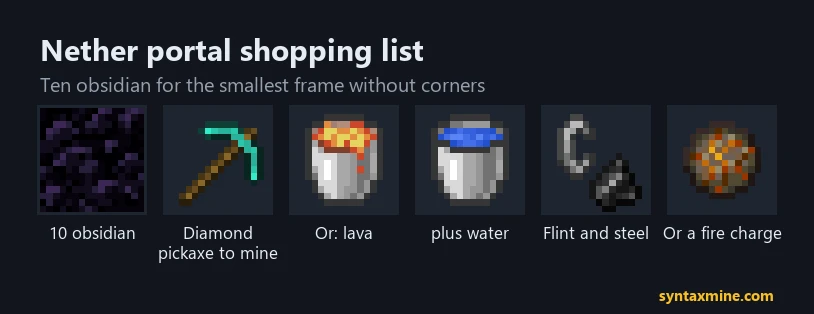 Image: SyntaxMine, made from Minecraft's own textures.
The frame
Build an upright rectangle of obsidian with a 2 wide, 3 tall hole in the middle. The four corner blocks do nothing, so you can leave them out. Portals generated by the game always include them, and many players add them for looks.
Only regular obsidian works. Crying obsidian looks similar but cannot be part of a portal frame. Bigger frames work too, up to a 21 by 21 opening.
Method 1: mine obsidian with a diamond pickaxe
Obsidian forms wherever water flows onto still lava. Find a lava pool, pour water over it, and mine the obsidian with a diamond or netherite pickaxe (nothing else can). Each block takes a while, about 9.4 seconds with an unenchanted diamond pickaxe, so Efficiency helps. You need 10 for the frame, plus a few spare.
Method 2: cast the frame from lava and water
No diamonds yet? You only need a bucket of water, a bucket of lava (or a lava pool nearby) and some ordinary blocks for a mould.
- Build a mould. Dig a trench or build a temporary dirt or cobblestone outline where the frame will go, so the lava has walls to sit against.
- Place the bottom row. Pour lava into one frame slot and pour water so it flows onto the lava. Still lava touched by water turns into obsidian. Pick the water back up.
- Repeat for each block, working upward. Hold the lava in place with a temporary block on the side away from the frame, turn it into obsidian, then remove the helper block.
- Remove the mould once all ten frame blocks are obsidian.
Two rules keep this safe: never stand downhill of lava, and keep the water source where you can grab it back. Lava flowing onto a lava source just spreads; it is water flowing onto still lava that makes obsidian.
Lighting the portal
Place fire inside the frame. The usual tools:
- Flint and steel: one iron ingot and one flint (from gravel).
- Fire charge: blaze powder, coal and gunpowder.
Lightning, fireballs and fire spreading into the frame can also light it. The fire has to be the last thing placed: if the frame is not complete or the opening is blocked, the fire just burns out.
The 8 to 1 rule and linking
Moving one block in the Nether moves you 8 blocks in the Overworld, horizontally. Height (Y) is not scaled. That is why the Nether is a fast-travel network: a 1,000-block trip in the Overworld is 125 blocks in the Nether.
When you step through, the game looks for an existing portal near the matching spot:
- In the Overworld, it searches 128 blocks in each direction around the converted coordinates.
- In the Nether, it searches only 16 blocks.
- If none is found, it builds a new portal nearby, and if there is no room it carves out a small obsidian platform for you to stand on.
Why portals link to the wrong place
Because the Overworld search is so wide, two Overworld portals close together often both lead to the same Nether portal. The fix is to build each portal's partner yourself at exactly matching coordinates:
- Note the Overworld portal's X and Z (press F3).
- Divide both by 8. That is where the Nether portal must stand.
- Build the Nether portal at those coordinates, at any height.
Our Nether portal calculator does the maths and gives you a build checklist.
Tips for the first trip
- Travel takes 4 seconds of standing in the portal in survival, instant in creative.
- Bring fire resistance potions or at least a stack of blocks: the Nether spawns you wherever there is room, sometimes beside a lava sea.
- Beds explode in the Nether, so do not try to set your spawn there; here is why.
- Zombified piglins can spawn on Overworld portal frames over time, more often on harder difficulties. Ring the portal with slabs or put it somewhere you do not mind company.
- Wear one piece of gold armor: piglins attack players without it.
Ruined portals scattered around the Overworld already have most of a frame, often with chests nearby; they are a cheap way to your first portal, and their history in the lore is a story in itself.
Frequently asked questions
How much obsidian do you need for a Nether portal?
Ten obsidian is enough for the smallest frame, 4 wide by 5 tall, because the four corners can be left out. With corners it takes 14.
Can you make a Nether portal without a diamond pickaxe?
Yes. Build a mould and cast each frame block in place: pour lava where the block goes, then let water flow onto it so it turns into obsidian. You need a water bucket and lava, but no pickaxe.
What can you light a Nether portal with?
A flint and steel or a fire charge, used inside a complete frame. Lightning, fireballs and spreading fire can also light it.
How do you link Nether portals correctly?
Divide your Overworld X and Z coordinates by 8 and build the Nether portal at exactly those coordinates. The Nether only searches 16 blocks for a partner, so matching coordinates keep each portal pair together.
Does crying obsidian work for a Nether portal?
No. Only regular obsidian forms a working frame. Crying obsidian is used for respawn anchors instead.

Comments
Loading...