
Minecraft Java 26.4 Snapshot 3 released on 6 October 2026, and it is the snapshot the 26.4 cycle was waiting for. After two engine-focused snapshots (Snapshot 1 and Snapshot 2), the full Ice Caves drop lands on Java: the biome, ice crystals, icicles, the frostbite, ice balls and the Freezing effect.
Bedrock players have had it for a week in Preview 26.60. This page is the Java version: the exact numbers, and where Java behaves differently.
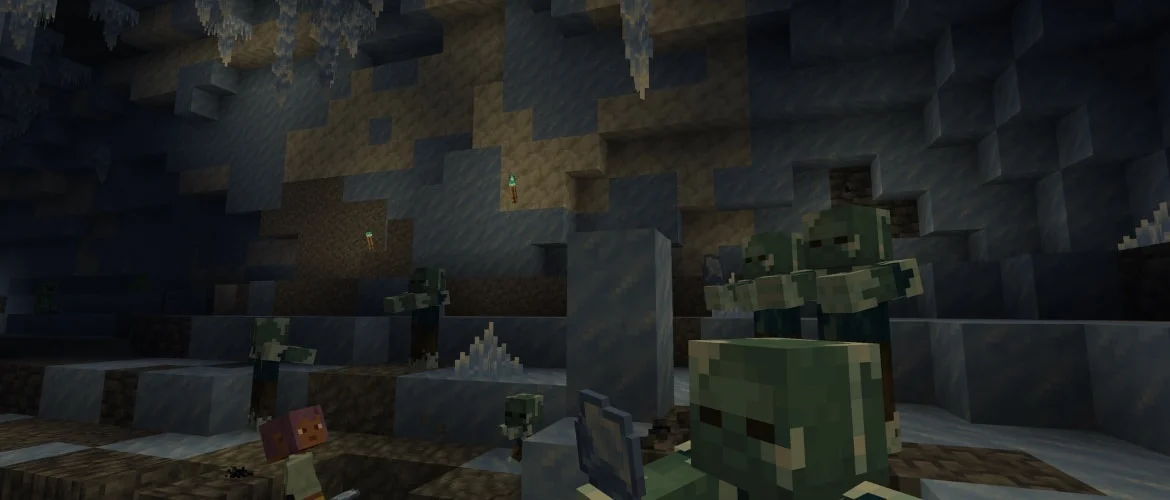 Image: Mojang Studios, from the official 26.4 Snapshot 3 announcement.
Snapshot values can change. Everything below is from Snapshot 3. Build test farms in a copy of a world, never your main save, and expect numbers to move before 26.4 releases.
Everything new, at a glance
| Feature | Java Snapshot 3 |
|---|---|
| Ice caves | Cave biome under the colder Overworld biomes |
| Ice crystals | Light source, placeable in any direction, breaks without support |
| Icicles | Grow up to 5 blocks in the dark, fall and damage, break near light |
| Frostbite | Zombie variant: 24 health, 2 armor, Freezing melee, ice ball throws |
| Ice ball | Projectile, 4 damage scaling with speed, knockback |
| Freezing | New mob effect, works like being stuck in powder snow |
| Potion and Arrow of Freezing | Brewed from ice balls; arrows use the normal tipped-arrow recipe |
The ice caves biome
Ice caves generate under the colder biomes of the Overworld. They are mostly packed ice and calcite, with icicles across the ceiling, large packed-ice icicles on floor and ceiling, occasional snow patches and ice crystals on the ground.
Two details matter for players who mine:
- Ores generate inside pockets of stone and deepslate. The technical notes explain how: each ice-cave ore placement (coal, copper, iron, gold, redstone, lapis and diamond, plus andesite, diorite and gravel) is identical to the normal one, except it first places a patch of stone or deepslate, depending on height, and then the ore inside it. Diamonds included, with the usual medium, large and buried variants.
- Glow lichen does not generate here, so the cave is darker than it looks in screenshots.
Mobs: everything that normally spawns in caves, plus strays and frostbites.
Ice crystals
A new block that Mojang compares to amethyst clusters. It emits light, can be placed in any direction, and breaks if its support block is removed. It generates occasionally on the floor of ice caves.
Icicles
A speleothem like dripstone and the sulfur spikes from 26.2:
- They generate all over ice cave ceilings and can be placed in any direction, with base, middle and tip variants.
- Pointing down, they grow up to 5 blocks long, but only without nearby light sources and outside the Nether.
- A falling icicle damages entities it hits, and landing on one deals extra damage.
- Pointed blocks break when a light source is nearby, or when placed in the Nether.
That last rule is the practical one: light breaks icicles, so a torch both makes a cave safe and clears its ceiling.
The frostbite, in numbers
The Java values, which are the ones farm builders need:
| Stat | Value |
|---|---|
| Health | 24 (12 hearts) |
| Armor | 2 |
| Melee damage | 2.5 Easy, 3 Normal, 4.5 Hard |
| Melee effect | Freezing for 3 seconds |
| Ice ball damage | 1 to 4, scaling with speed on impact |
| Converts from | Zombie or husk after 22 seconds in powder snow (keeps its gear) |
| Converts to | Zombie after 30 seconds underwater |
| Drops | Rotten flesh 0 to 2, ice ball 0 to 3 (75% chance) |
| Immune to | Freezing, powder snow slowdown; can stand on powder snow |
It switches between melee and ranged based on distance and whether it has ice balls left. Note the health: 24, more than a normal zombie's 20. Any fall-damage kill chamber built for zombies will leave frostbites with health to spare.
Where frostbites spawn
In Java, frostbites have spawn weights in nine cold biomes. Ice caves are the strongest by far:
| Biome | Share of hostile spawns |
|---|---|
| Ice caves | 9.62% |
| Frozen peaks, ice spikes, frozen river | about 4.6% each |
| Frozen ocean, deep frozen ocean | about 4.6% each |
| Snowy slopes, jagged peaks, snowy plains | about 1.9% each |
The conversion route, zombies and husks turning into frostbites after 22 seconds in powder snow, is the other source, and the one that makes an ice ball farm practical. Our ice ball farm mechanics guide, coming next, covers both routes in detail.
Ice balls and the Freezing effect
Ice balls deal 4 damage, scaling down with velocity, have knockback, and break on impact with a particle effect and sound.
Freezing makes the affected entity shake and slowly freeze as if stuck in powder snow, then take damage. Three rules decide how it plays:
- Leather armor protects you from the freezing, just like in powder snow, but it does not stop the effect being applied and does not remove it.
- Mobs take additional damage from freezing while the effect is on them, and mobs that are vulnerable to freezing take five times the damage.
- Frostbites themselves are immune.
Recipes
- Potion of Freezing: brew with an ice ball. Splash and lingering versions follow the normal brewing rules (see the brewing guide).
- Arrow of Freezing: a lingering Potion of Freezing in the center of the crafting table, surrounded by eight arrows.
Java vs Bedrock: what differs
Comparing the Java Snapshot 3 notes with the Bedrock Preview 26.60.29 notes:
| Java Snapshot 3 | Bedrock Preview 26.60.29 | |
|---|---|---|
| Surface ice caves | Not mentioned in the notes | Ice caves occasionally generate on the surface |
| What does not generate | Glow lichen | Glow lichen, dirt and granite |
| Leather armor | Protects from freezing like powder snow; effect still applies | One piece prevents the damage, not the slowness |
| Extra damage while frozen | Mobs take additional freezing damage while affected | Not described the same way |
| Icicle placement | Any direction, base/middle/tip variants | Ceiling generation, can be placed on the ground |
| Ice ball | 4 damage, scales with speed, knockback | 4 damage, scales with speed |
Some of these may be wording rather than real differences, since each edition writes its own notes. The ones to test before relying on them are leather armor and surface generation.
Other changes in Snapshot 3
Gameplay tweaks
- Snow can now be placed on packed ice.
- Snowballs now apply knockback to players. That is a change for PvP, where snowballs were harmless until now.
Social screens
- Social Interactions is replaced by a new Other Players screen (default key P), available on LAN worlds, servers and Realms. It lists players online now, players who just left, and players who recently chatted.
- The Friends list was redesigned, with search and sorting (online first, or alphabetical).
- A new Player Options screen gathers friend requests, muting and reporting for each player.
Debug overlay (configurable with F3 + F6)
- A configurable lightmap visualization,
lightmap_texture, in the Light group. - A new
chunk_section_statusentry shows the rendering status of nearby chunks. It costs performance at high view distances. - Chunk loading was split out of
visualize_chunks_on_serverinto a newchunk_load_statusentry. That one is useful for anyone checking whether a chunk loader actually keeps its chunks loaded.
For data pack and resource pack authors
- Data pack format 123.0 (Snapshot 2 was 122.1), resource pack format 100.0 (was 99.0).
minecraft:speleothem_clustergainedplacement_options: aplacement_mode(floor_and_ceiling,floor_only,ceiling_only), abase_block_transformer(noneorset_attached), andallow_water_placement.minecraft:large_speleothemwas renamed tominecraft:large_dripstoneand gained abase_blockfield.- A new noise,
ice_cave_gradient, and the full set ofice_cave_ore_*placements. - A new
minecraft:block_sound_setregistry defines block sounds (break, step, place, hit, fall) with optional volume and pitch. - A new
iceblock tag.
If a pack breaks, how to install datapacks covers the usual causes.
Frequently asked questions
Are Ice Caves in Minecraft Java now?
Yes, in 26.4 Snapshot 3 (6 October 2026). They are not in a full Java release yet.
How much health does a frostbite have?
24 health (12 hearts) and 2 armor in Java, more than a regular zombie.
How do zombies turn into frostbites?
A zombie or husk becomes a frostbite after 22 seconds in powder snow, keeping its equipment. A frostbite turns back into a zombie after 30 seconds underwater.
Do frostbites always drop ice balls?
In Snapshot 3 they drop 0 to 3 ice balls with a 75% chance, plus 0 to 2 rotten flesh.
How do you craft an Arrow of Freezing?
Put a lingering Potion of Freezing in the middle of a crafting table and surround it with eight arrows.
What are the pack formats in 26.4 Snapshot 3?
Data pack 123.0, resource pack 100.0.