JavaRandom: the machine that uses the seed
The seed on its own does nothing. It's input to a pseudorandom number generator (PRNG): a deterministic algorithm that produces a sequence of numbers which appear random but are fully determined by the starting value.
Minecraft Java Edition uses java.util.Random, an implementation of a Linear Congruential Generator (LCG). The formula is:
nextSeed = (seed × 6364136223846793005 + 1442695040888963407) & ((1L << 48) - 1)
Each call to the generator takes the current state, multiplies it by a large constant, adds another large constant, and masks the result to 48 bits. The output for any given call is the top bits of the result.
Three properties define this generator's usefulness for world generation:
- Deterministic: the same starting seed always produces the same sequence of numbers
- Fast: the calculation is a single multiplication, addition, and bitwise AND; trivially fast even for millions of calls
- Reversible: given the output of one call, you can calculate the previous state. This property, as we'll see, is what makes seed crackers possible.
The LCG is not cryptographically secure. If you see several outputs in sequence, you can determine the full state and predict all future outputs. For world generation, this is fine; worlds don't need to be unpredictable, they need to be reproducible.
From seed to world: the generation pipeline
A single world seed flows through several independent generation systems. Each system uses the seed as a starting point but mixes it with additional constants ("salts") to ensure that, say, the cave generator and the structure placer don't produce identical patterns.
The high-level pipeline for 26.2:
World Seed
    ↓
  Biome Generation (climate noise)
    ↓
  Terrain Generation (surface + underground noise)
    ↓
  Cave Carvers (spaghetti, cheese, noodle)
    ↓
  Surface Decoration (trees, grass, flowers)
    ↓
  Structure Placement (villages, temples, strongholds)
    ↓
  Structure Generation (actual block placement)
    ↓
  Feature Scatter (ore veins, geodes, spawner placement)
Each stage takes the world seed, mixes it with a stage-specific salt, and generates content. Changing the world seed changes everything simultaneously, because every stage reads from the same root.
Biome generation: five axes of infinite space
The most significant change in Minecraft's generation history happened in 1.18, when Mojang replaced the old temperature/humidity grid with a five-dimensional climate space system called the Biome Parameter system (or informally, "climate axes").
Before 1.18, biomes were placed on a 2D grid with Voronoi-like noise for temperature and humidity. The result was correct but visually boring; biomes were roughly the right size and adjacency, but there was no connection between the terrain shape and the biome.
In 1.18, every point in the world is defined by five climate values:
- Temperature: cold to hot
- Humidity: dry to wet
- Continentalness: how far from a coast (low = ocean, high = inland)
- Erosion: how flat or mountainous (high erosion = flatter terrain, low erosion = dramatic peaks)
- Weirdness: a secondary noise that creates local variation within each biome
Each of these five axes is a separate noise function evaluated at the world coordinates. The five resulting values form a point in a 5D climate space. Mojang pre-defined specific regions of that space and labeled them biomes: "this region of climate space is a Cold Peaks biome, this region is a Sparse Jungle, this region is a Deep Dark."
The Deep Dark, specifically, requires:
- Low continentalness (underground, not near coasts)
- Low depth (deep underground)
- Specific weirdness range that places it in the Jagged Peaks / Frozen Peaks "column"
This is why Ancient Cities appear under snowy mountain ranges specifically: the climate parameters that produce those mountains at the surface produce Deep Dark at depth.
The newest biome to join this system is 26.2's sulfur caves, which pick their spots the same way: a specific band of continentalness, erosion, and weirdness, which in practice puts them under flatland near swamps and deserts. Our sulfur caves guide covers how to read their surface markers (geysers and sulfur springs) instead of computing climate axes by hand.
The five noise functions are derived from the world seed. Different seeds produce different climate landscapes, which is why the distribution and size of biomes varies dramatically between seeds; some seeds produce enormous oceans, others have nearly none; some place mountain ranges across whole continents, others create low rolling hills everywhere.
Terrain generation: how mountains emerge from noise
Terrain height is calculated using simplex noise: a faster, less artifact-prone successor to Perlin noise invented by Ken Perlin in 2001 and implemented in Minecraft by the Mojang worldgen team.
Simplex noise produces smooth, continuous values between −1 and +1 at any coordinate in 3D space. Layer several octaves of simplex noise at different scales and you get fractal-like terrain: broad continental shapes at large scale, smaller hills within those, rocky detail at fine scale.
For 26.2, the terrain generator combines:
- A density function: a 3D noise field that determines whether each block position is solid or air
- The continentalness and erosion biome parameters as multipliers on vertical scale
- Spline curves that map climate values to target terrain heights
The result: mountains exist because the erosion noise value is low at those coordinates, which tells the density function to expect high terrain at high altitudes. The mountain isn't placed there; it is there because the math says so, deriving from the seed, flowing through the noise, producing stone where the density is above a threshold and air where it isn't.
This system makes terrain and biomes consistent: a Frozen Peaks biome always has high terrain because the same climate parameters that label a region "Frozen Peaks" also produce the low-erosion noise values that drive terrain upward. The biome label and the terrain shape are two expressions of the same underlying climate data.
Cave generation: cheese, spaghetti, and noodles
The 1.18 cave overhaul replaced the old tunnel-carver algorithm with three separate noise-based cave types, each derived independently from the world seed:
Cheese caves are the large, open caverns that look like irregular rooms, named for the holes in a slice of Swiss cheese. Generated by a 3D noise field: where noise value falls below a threshold, the cave exists. The large horizontal extent of cheese caves makes them the main light source for deep underground biomes and the reason Ancient Cities often have dramatic open ceilings (what those cities are doing down there is the subject of our Ancient Builders lore deep-dive).
Spaghetti caves are the long, sinuous tunnels. Generated by a pair of noise functions that define a curved tube through 3D space. The "spine" of the tube curves through terrain following one noise function; the radius of the tube follows another. This produces the familiar winding corridors that connect different cave layers.
Noodle caves are narrower, more branching variants of spaghetti caves: thinner tunnels that create the labyrinthine complexity in middle depths. Named by the community for resembling, obviously, noodles.
All three systems operate independently but interact: a spaghetti cave can punch through a cheese cave, creating an opening into a larger chamber. A noodle cave can split off a spaghetti tunnel, creating dead-end passages. The intersections are not planned; they're emergent from three independent noise systems sharing the same underlying seed.
The aquifer system (also new in 1.18) adds local water and lava levels: pockets of the underground can have their own sea levels, which is why you find flooded caverns next to dry tunnels at the same depth. Aquifer boundaries are determined by another noise field seeded from the world seed.
Structure placement: salt values and candidate positions
Structures don't just appear randomly. They are placed through a three-stage process that ensures they're reproducible, distributed, and don't pile up at the world origin.
Stage 1: Grid division. The world is divided into regions; for villages, the region is 34x34 chunks. Each region gets exactly zero or one structure attempt.
Stage 2: Candidate position. Within each region, the game picks a candidate chunk using a random number generator seeded with:
seed = worldSeed + regionX × saltA + regionZ × saltB + structureSalt
The structureSalt is a constant unique to each structure type: 10387319 for villages, 34222645 for pillager outposts, and so on. This salt ensures that villages and outposts don't correlate spatially even though they use the same grid-division logic.
Stage 3: Validity check. The candidate chunk is checked for terrain suitability. Villages require flat-ish land in a village-compatible biome. Strongholds require... well, that's a special case.
Strongholds are different. They don't use the grid system. Instead, Minecraft generates strongholds in rings around the world origin:
- Ring 1: 3 strongholds, 1280-2816 blocks from origin
- Ring 2: 6 strongholds, 4352-5888 blocks
- Ring 3: 10 strongholds, 7424-9472 blocks
- ...continuing to ring 8 with 128 strongholds per ring
The exact angular positions within each ring are determined by the world seed. This is why /locate structure stronghold sometimes sends you north and sometimes south; the strongholds' angular positions rotate based on the seed.
Trial Chambers (added in 1.21) use a dense grid (region size: 34x34 chunks, same as villages) with high spawn probability; they're designed to be encountered frequently. Their interior layout varies because the room-connection algorithm uses a different random call seeded from the structure's chunk position.
The Far Lands: what happens at the edge of the number
Before Beta 1.8, Minecraft used a different noise function for terrain generation that had a mathematical flaw: at extreme distances from the world origin, floating-point precision errors accumulated until the terrain generator produced completely invalid output. The result was the Far Lands: a wall of bizarre, cheese-like terrain that appeared at approximately +/-12,550,820 blocks from origin in any cardinal direction.
The Far Lands were fixed in Beta 1.8 and no longer exist in any current version. But they were never truly gone from the generation algorithm; they were replaced by a different noise function, not patched. Players found that modifying specific parameters could recreate the effect.
More importantly, the Far Lands revealed something real: floating-point numbers have limited precision, and world generation uses floats extensively. At extreme distances (beyond +/-30,000,000 blocks, the "world border" default), modern Minecraft still has precision issues; not the same dramatic terrain collapse, but visual glitches and physics anomalies that accumulate with distance.
The Far Lands became mythology partly because they genuinely looked alien (otherworldly, infinite in both directions, mathematically inevitable) and partly because they were accidentally discovered, not designed. No one at Mojang intended the Far Lands to exist. The universe generated them anyway.
The Minecraft@Home project: finding the title screen seed
Every time you launch Minecraft, you see the title screen panorama: a world with a distinctive savanna/forest transition, specific trees visible at specific angles, a particular sky colour at a particular time of day.
Minecraft players have stared at that panorama for over a decade. And someone, eventually, asked: what is the seed?
The Minecraft@Home project launched in 2020 with the goal of finding it. The project used distributed computing (volunteers running the search on their own hardware, coordinated through a central server) to crack the problem. The challenge:
- The title screen panorama is a specific screenshot taken in a specific world
- The world has a seed: some 64-bit integer
- The screenshot shows enough terrain detail to constrain the seed significantly
- But there are still potentially billions of candidate seeds
The search methodology exploited the 48-bit structure of JavaRandom. Even though seeds are 64-bit, the biome and terrain generators make enough independent calls that the search space can be dramatically reduced by looking for seeds that produce the right biome pattern at the right coordinates. If you can establish that the title screen world has, say, a specific biome boundary at a specific location, you eliminate all seeds where that boundary doesn't exist, which might be 99.99% of them.
After months of distributed computation across thousands of volunteer machines, the project narrowed the field and found the seed: 2151901553968352745 (for Java Edition 1.7.10, the version the panorama was taken on).
The coordinates of the screenshot: approximately X: 61.48, Y: 75, Z: −68.73, facing angle 90.00°.
The find was significant not because the seed itself is useful (you can't load it and walk to the spot on a modern version, as the terrain generation changed too much between 1.7 and 1.18) but because of what it demonstrated: no seed is truly secret if you have enough information about the world it generates. The universe of possible worlds is finite, searchable, and addressable.
Seed crackers: reverse-engineering the universe
JavaRandom's reversibility has practical consequences beyond historical archaeology. Because the LCG algorithm is reversible, a seed cracker can determine your world seed from a small number of observations.
The core vulnerability: ore generation uses JavaRandom directly. If you observe the positions of several ore deposits in a chunk, each position was generated by a specific sequence of JavaRandom calls. Because you know which call produced which position (the call order is fixed by the algorithm), you can reverse the sequence and recover the RNG state for that chunk, which you can then use to recover the world seed.
In practice, the most well-known seed crackers (such as Nether Fortress Seed Finder or the seedcracker mod) work differently; they exploit structure placement, which uses a simplified version of the seed mixing that's easier to reverse. If you see a Nether fortress at a specific chunk position and know the salt value for Nether fortresses, you can enumerate the seeds that would place a fortress exactly there. Cross-reference with a second structure at a known position, and the seed space collapses to a single value.
The SeedCracker mod by 19MisterX98 can find your world seed in a few minutes by observing Nether fossils, decorators, or structure positions. It runs passively in the background and reports the seed when it has enough data. On multiplayer servers, this means any player can find the server seed without operator access, just by exploring.
This has serious implications for competitive Minecraft. Any server whose seed is unknown can have it recovered by a determined player. The solution: use a seed with no structures, use Fabric mods that suppress seed-revealing information, or accept that your seed is ultimately public information.
2b2t and the archaeology of lost coordinates
2b2t (2builders2tools) is the oldest continuously-running anarchy Minecraft server, active since 2010. It has no rules, no resets, and no wipes. The map has been accumulating history for over 15 years.
The server's seed was a closely guarded secret for years; knowing the seed meant knowing where structures generated, which meant knowing where players might have built ancient bases in the map's early years, when the population was small and everything built near spawn or near structures.
In 2019, the seed was cracked. A player called Negative Entropy observed enough structure positions across the map to narrow the seed space, then ran a distributed cracking effort. The result: the 2b2t seed is -4172144997902289642.
The discovery triggered one of the largest "base hunting" efforts in Minecraft history. Players used the seed and structure placement algorithms to calculate every stronghold, every ocean monument, every desert temple that had ever generated on 2b2t, then checked those coordinates for ancient bases. They found ruins of settlements, chests with decade-old loot, griefed megastructures that had been buried and forgotten.
The seed cracking didn't just reveal structure locations. It revealed the shape of the server's history: where people had congregated in 2011, what they'd built, where they'd hidden. Fifteen years of human activity on a Minecraft server, encoded in a single 64-bit integer.
Seed 0 and the special case of zero
Every number has a seed, including zero. Seed 0 is not blank; it is the explicit integer 0, which produces a specific world just like any other seed.
In early Minecraft versions, seed 0 had a notable property: the world generation used 0 * constant + offset = offset at the first LCG step, which produced a specific starting RNG state. The resulting world was not blank or degenerate; it was a fully valid, visually normal world, but it had predictable structure placement that speedrunners and mapmakers studied extensively.
In 1.18, the terrain generator was substantially reworked, so seed 0's special mathematical property was diluted through enough mixing that it no longer produces notably different behaviour. But the tradition of treating it as interesting persists in the community.
The philosophical point: the Library of Babel
In 1941, Jorge Luis Borges wrote a short story called The Library of Babel: a universe consisting of a vast library containing every possible book of a specific length. Because the library contains every possible combination of letters, it contains every true book ever written, every book that will ever be written, and every book that could ever be written, mixed with an overwhelming majority of meaningless noise.
The Minecraft seed space is a digital Library of Babel.
Within the 18.4 quintillion possible seeds, there exists a world that generated every possible landmark at every possible location: a world where the stronghold generates directly under a village, where the trail ruins spell out a recognizable pattern, where mountain peaks precisely mirror the skyline of a real city. These worlds exist. We'll almost certainly never find them, but they are there, addressed by specific numbers, waiting.
More importantly: your first Minecraft world exists at a specific address. The mountain you climbed on the first night, the ravine that opened under your house, the jungle you never explored to the east; all of it is encoded in a number stored in level.dat. If you lost that world, the number still exists. The world still exists. You just can't get back there.
Every world is simultaneously unique and permanent. The seed is not a recipe for building a world; it is a coordinate: an address in the space of all possible worlds, one of which is yours.
How to use seeds in practice
Finding a seed for your next world:
- Chunkbase.com: seed analysis tool. Enter a seed and version, see all structure positions, biome maps, and slime chunk data before generating the world.
- Minecraftathome.com: seed research and distributed analysis projects.
Finding seeds for specific features:
- Chunkbase's seed finder lets you filter for seeds with specific biome configurations (jungle near spawn, mushroom island at specific coordinates, etc.). Slime-chunk data from the same tool pairs well with our Mob Spawner Optimizer when you're picking a perimeter site.
- The Cubiomes library is a C reimplementation of Minecraft's generator: orders of magnitude faster than running the game, used for large-scale seed searches.
What your current seed reveals:
Press F3 in-game → "Seed:" line → that number is the address of your universe. You can give it to anyone, they can generate an identical world (same version), and explore places you've never been. The world extends infinitely in all four directions, and you've only seen a small cube of it. (How much of it stays loaded and ticking around you is a different system entirely, covered in chunk borders and ticket levels.)
Protecting your seed on a server:
If you run a multiplayer server and want to keep the seed private, install AntiXray (hides ore positions from clients) and avoid letting players observe structure distributions. With enough structure positions, the seed is recoverable; there is no cryptographic defense, only information restriction.
The generation pipeline in 26.2: what's new
The terrain generation in 26.2 is built on the 1.18 foundation with several additions:
- Trial Chambers (1.21): placed using grid-based generation with high density, interior layout uses a maze-generation algorithm seeded from the structure position
- Copper geodes: generated as a separate feature pass after terrain, using a noise mask that places them in specific depth ranges
- Bogged spawners: placed in swamp Trial Chambers using position-seeded random; swamp biomes use the same climate-axis system as all other biomes
- Bundles: not a generation feature, but the 26.2 update to bundle mechanics means players can now carry more inventory across the infinite generated world, which changes what's worth exploring
The generation pipeline itself is unchanged from 1.18's architecture. Mojang has added features on top but has not replaced the noise-based biome and terrain system; it is, for now, the stable foundation.
Every time you press Create New World, you're not creating anything. You're opening a window into a coordinate in an 18-digit address space: a universe that was always there, has always had the exact same mountains in the exact same places, and will continue to exist whether or not you ever return to it.
The seed is not magic. It's math. But the math produces something that functions, for every practical purpose, like infinity, and it does so from a number that fits in a text field.
That's the thing that doesn't get smaller the more you understand it.
Frequently asked questions
Do Minecraft seeds work the same across versions?
No, not reliably. World generation has changed substantially over time (the biome system alone was overhauled in 1.18), so the same seed typed into an old version and a current one can produce very different terrain; the Minecraft@Home team could not simply reload the title screen seed on a modern version and walk to the original coordinates, because generation changed too much between 1.7 and 1.18.
Do Java and Bedrock seeds produce the same world?
No. This article covers Java Edition specifically, which uses Java's java.util.Random (a Linear Congruential Generator) for its world generation math. Bedrock Edition uses a different generation implementation entirely, so the same numeric seed will not produce matching terrain between the two editions.
Can I find the seed of an existing world?
Yes, if it is your own world: press F3 in-game and look for the "Seed:" line in the debug overlay, or open the world folder and read the seed value from level.dat with an NBT editor. Finding someone else's server seed without access is a different problem, covered by seed cracking, which reverse-engineers the seed from observed structure or ore positions using JavaRandom's reversibility.
Can you change the seed of an existing world?
No, not the terrain that has already generated. The seed determines the entire generation pipeline (biomes, terrain, caves, structures) from world creation onward, so changing it would only affect chunks that have not been generated yet, producing an inconsistent seam where old and new terrain meet. There is no vanilla mechanism to re-seed an existing world's already-generated chunks.
Is it possible to find your Minecraft server's seed without admin access?
Yes, in practice. Tools like the SeedCracker mod can determine a world seed in minutes by passively observing structure positions, decorators, or ore placements, because structure placement and ore generation both derive from JavaRandom calls that are mathematically reversible. This is exactly how the 2b2t server seed was recovered in 2019 by a player with no operator access.
How many possible Minecraft seeds are there?
Exactly 18,446,744,073,709,551,616 (2^64, about 18.4 quintillion), because a Java Edition seed is a 64-bit signed integer that can be negative or positive. Not every seed produces a completely different world, though: some generation steps use only 48 bits of the seed, so seeds that differ only in their upper bits can share structure positions. The vast majority of the space has never been explored by anyone.
Sources and further reading:


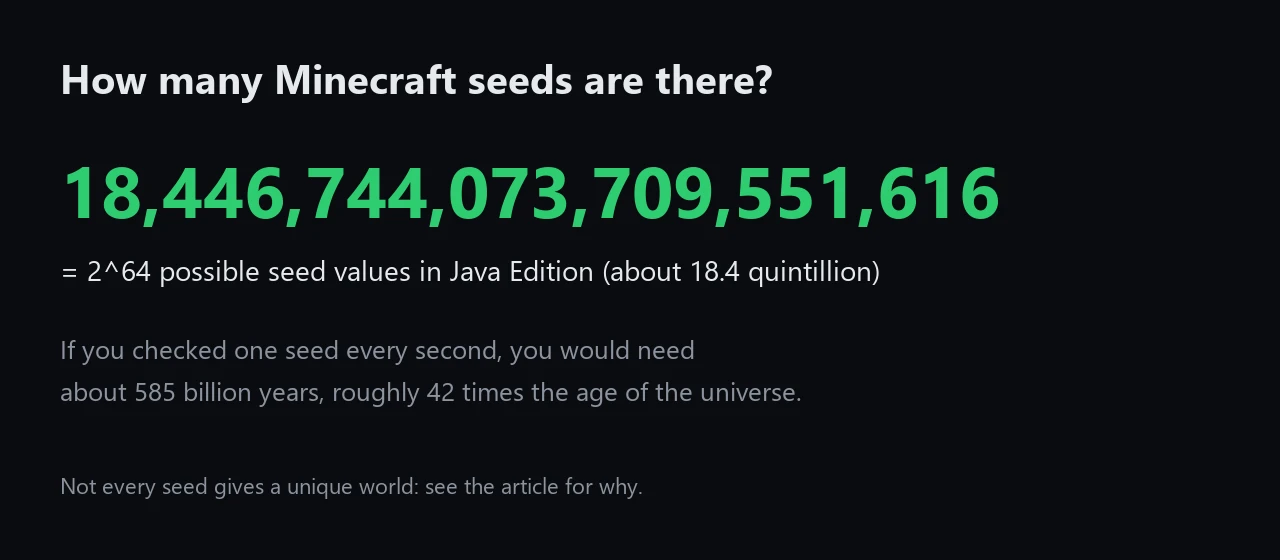 Diagram: SyntaxMine.
Comments
Loading...