Poplar is the new wood type in Minecraft 26.3 "Wilderness Bound". Its trees grow only in the new dappled forest, with dark bark and a big canopy of red, orange or yellow leaves. It comes with a complete block set, from planks and logs to doors, signs, boats and shelves, and its muted grey-brown planks fill a gap in the wood palette that builders used to fake with stripped logs and sandstone.
This page covers every poplar block and how to craft it, where to find poplar trees, how the leaf colors work, and five block palettes that show what poplar is good for.
Up to date for 26.3. Poplar shipped with Minecraft 26.3 on 15 September 2026 and has not changed since. It is not in 26.4 snapshots as a new feature; it is simply part of the game now.
RateFull wood set from one tree
XP levelN/A
Build timeAdded in 26.3 (15 September 2026)
DifficultyBeginner
Every poplar block, and how to craft it
Poplar follows the same recipes as every other wood. Start with logs from a poplar tree and everything else comes from a crafting table or an axe.
| Block |
How you get it |
| Poplar Log |
Chop a poplar tree |
| Stripped Poplar Log |
Use an axe on a poplar log |
| Poplar Wood / Stripped Poplar Wood |
4 logs (or stripped logs) in a 2x2 square, makes 3 |
| Poplar Planks |
1 log, makes 4 planks |
| Poplar Stairs |
6 planks, makes 4 |
| Poplar Slab |
3 planks in a row, makes 6 |
| Poplar Door |
6 planks, makes 3 |
| Poplar Trapdoor |
6 planks, makes 2 |
| Poplar Fence |
4 planks and 2 sticks, makes 3 |
| Poplar Fence Gate |
4 sticks and 2 planks |
| Poplar Sign |
6 planks and 1 stick, makes 3 |
| Poplar Hanging Sign |
6 stripped poplar logs and 2 chains, makes 6 |
| Poplar Button |
1 plank |
| Poplar Pressure Plate |
2 planks |
| Poplar Shelf |
Crafted from stripped poplar logs |
| Poplar Boat / Boat with Chest |
5 planks; add a chest for the chest version |
| Poplar Sapling |
Drops from poplar leaves |
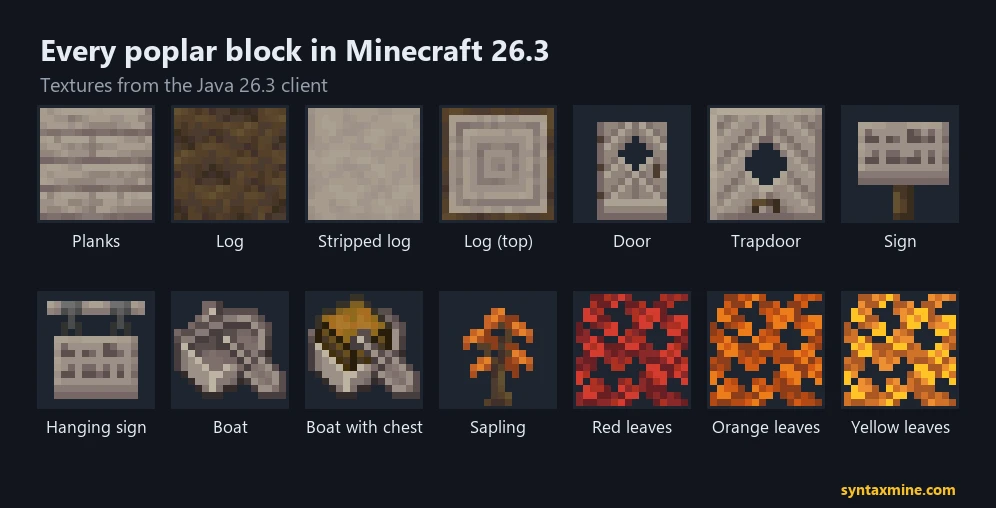 Image: SyntaxMine, made from Minecraft's own block textures.
Two related blocks come from the same biome: the red shrub and the shelf mushroom, which grows on poplar trunks.
What poplar planks and logs look like
Poplar planks are a muted grey-brown, close to taupe: darker and warmer than pale oak's near-white, greyer than birch or oak, with none of the yellow of bamboo or the pink of cherry. The bark is dark brown and stripped poplar is a pale, soft grey. It is a cool neutral, which is exactly why it is useful: it carries the walls of a build quietly and lets warm accents, like poplar's own red, orange and yellow leaves, do the talking.
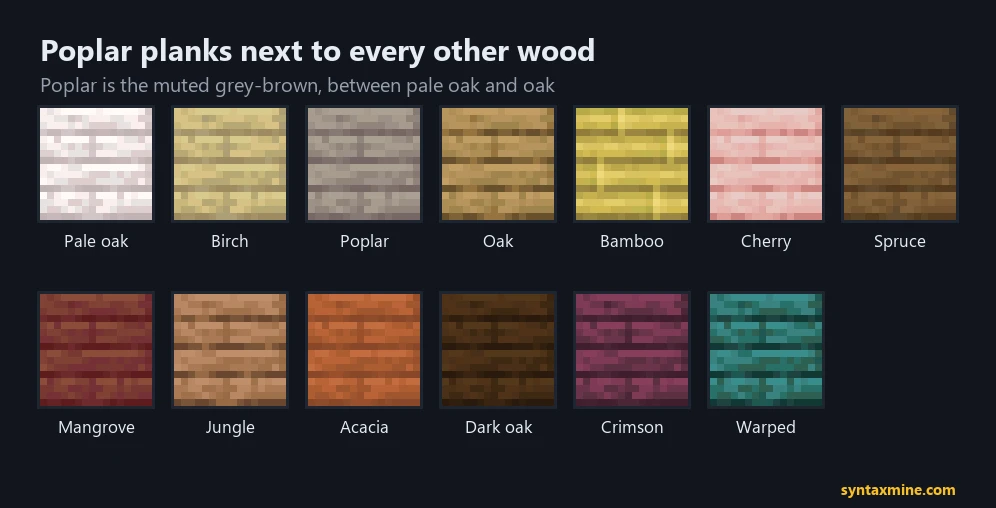 Image: SyntaxMine, made from Minecraft's own block textures.
| Wood |
Tone |
Reads as |
| Oak |
Warm mid-brown |
Default, general purpose |
| Birch |
Pale cream |
Clean, minimal |
| Spruce |
Cool dark brown |
Rustic, mountain |
| Dark oak |
Near-black brown |
Heavy, contrast trim |
| Cherry |
Pink-white |
Soft, pastel |
| Mangrove |
Deep red-brown |
Bold, tropical |
| Poplar |
Muted grey-brown (taupe) |
Calm, weathered, cool neutral |
Five poplar build palettes
Each palette is a set of blocks that look good together. Use the first block for most of the surface, the rest for frames, roofs and details.
1. Autumn cabin
Poplar planks, spruce logs, stripped spruce, cobblestone, red poplar leaves.
Poplar walls with spruce frames and roof, cobblestone base. The darker spruce frames the grey-brown poplar, and the colored leaves supply the warmth. Put a red or orange poplar tree next to it and the build matches the dappled forest around it.
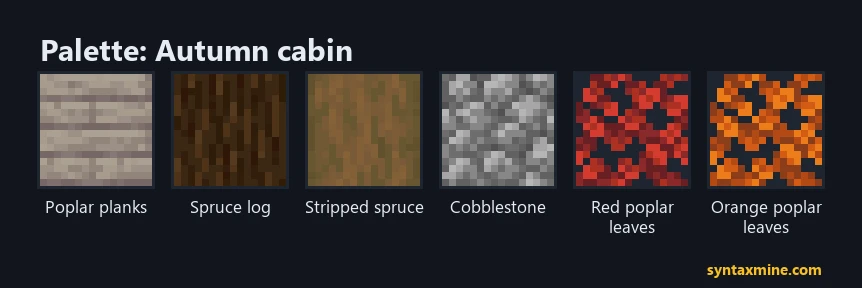 Image: SyntaxMine, made from Minecraft's own block textures.
2. Soft modern
Poplar planks, smooth stone, deepslate tiles, glass panes, white concrete.
Poplar against cool grey stone reads clean and modern instead of rustic. Big windows, flat roofs, poplar used for floors and interior walls.
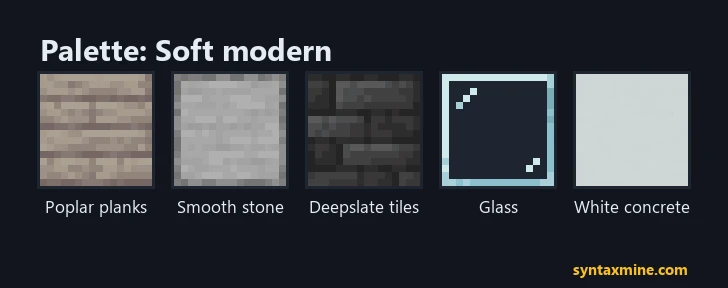 Image: SyntaxMine, made from Minecraft's own block textures.
3. Copper workshop
Poplar planks, stripped poplar logs, cut copper, exposed copper, tuff bricks.
Copper's orange is a warm accent against poplar's cool neutral, so copper trim and roofs stand out without clashing. Tuff bricks keep the base heavy. Copper oxidizes over time, which shifts the palette from warm to green as the build ages.
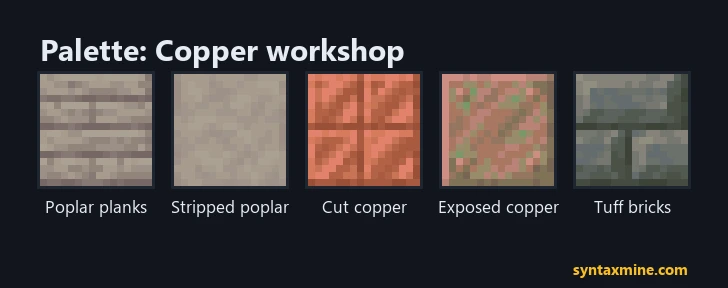 Image: SyntaxMine, made from Minecraft's own block textures.
4. Harvest barn
Poplar planks, poplar fence, hay bales, orange terracotta, dark oak logs.
A farm build that echoes the autumn leaves. Dark oak logs for the frame give contrast, orange terracotta and hay add color.
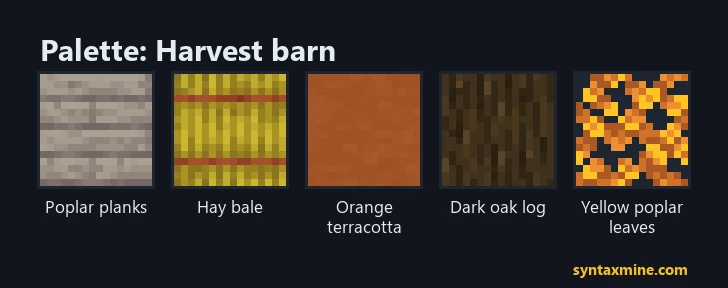 Image: SyntaxMine, made from Minecraft's own block textures.
5. Dappled garden
Poplar leaves (all three colors), leaf litter, coarse dirt, mossy cobblestone, poplar fence.
For the landscaping around a build: mix the three leaf colors in a row of trees, scatter leaf litter on coarse dirt, and edge paths with mossy cobblestone. It recreates the dappled forest floor anywhere.
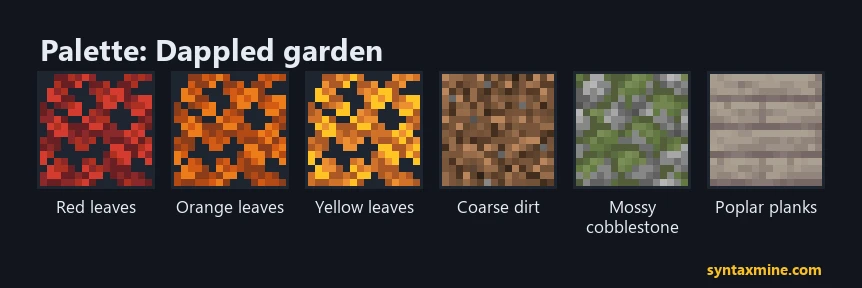 Image: SyntaxMine, made from Minecraft's own block textures.
Wool and concrete stairs help here too. Since 26.3, every wool and concrete color has stairs and slabs, which makes orange, yellow and red trim much easier. See what wool and concrete stairs unlock.
Where to find poplar trees
Poplar trees grow only in the dappled forest, the autumn-colored biome added in 26.3. It generates near cold biomes such as taiga and snowy areas, not near jungles or deserts. Inside the biome, poplar is the main tree, so one dappled forest gives you as much wood as you need.
Things to know before you go:
- New chunks only. The dappled forest only appears in newly generated terrain. In an old world, travel past the edge of what you have explored, ideally toward cold biomes.
- Fallen poplars. The biome also has fallen trees: a stump, a log lying on its side 4 to 7 blocks long, or both. They are free logs, no climbing needed, often with mushrooms on top.
- More in the biome guide. Shelf mushrooms, red shrubs and the abandoned camps that spawn there are covered in the dappled forest guide.
Leaf colors: red, orange and yellow
Every poplar tree has one of three leaf colors: red, orange or yellow. The color is chosen at random when the tree grows, and it is not inherited: a sapling from a red tree can grow into an orange or yellow one.
If you want a specific color for a garden, plant several saplings, keep the trees that land on your color, and collect saplings from those. It is a numbers game, not a recipe. Falling leaf particles match each tree's color, which is what gives a dappled forest its look.
Farming poplar wood
Poplar saplings need light level 9 or more and room above them to grow. Bone meal makes them try to grow instantly; if there is not enough space, nothing happens and the sapling stays. They can be planted on dirt, grass, coarse dirt, podzol, moss, mud and similar blocks.
Once you have saplings, poplar works in a normal tree farm: plant, bone meal, chop, replant. Its large canopy means it needs more headroom than oak, so leave plenty of vertical space in the farm.
Frequently asked questions
How do you get poplar wood in Minecraft?
Find a dappled forest, the autumn biome near cold biomes, and chop the poplar trees there. Logs turn into planks and every other poplar block at a crafting table.
What do poplar planks look like?
A muted grey-brown, close to taupe: darker than pale oak, greyer than birch or oak. The bark is dark brown and stripped poplar is pale grey. It works well as a calm main wall material.
Where do poplar trees grow?
Only in the dappled forest biome, which generates near cold biomes like taiga and snowy terrain. Fallen poplar logs also lie on the forest floor.
What color are poplar leaves?
Red, orange or yellow. Each tree gets one at random when it grows, and saplings do not inherit their parent's color.
What blocks go well with poplar wood?
Spruce and cobblestone for a cabin look, smooth stone and deepslate for a modern look, copper and tuff for an industrial look, and orange terracotta or hay for farm builds.
Can you farm poplar?
Yes. Plant saplings at light level 9 or more with enough room above, use bone meal to speed them up, and chop them like any other tree.
Everything else in the drop is on the 26.3 hub, and the biome itself is covered in the dappled forest guide.
Sources: