Ice balls are the ingredient behind every Potion of Freezing and every Arrow of Freezing in the Ice Caves drop, and in 26.4 Snapshot 3 they have exactly one source: frostbites. There is no recipe, no trade and no chest loot.
That makes ice balls a farm problem. This guide covers the mechanics that decide how an ice ball farm works, with the Snapshot 3 numbers, and it is honest about one thing up front: this is a snapshot feature, and nobody has a proven, finished design yet. What follows is the groundwork you need to build one, and the open questions you will hit.
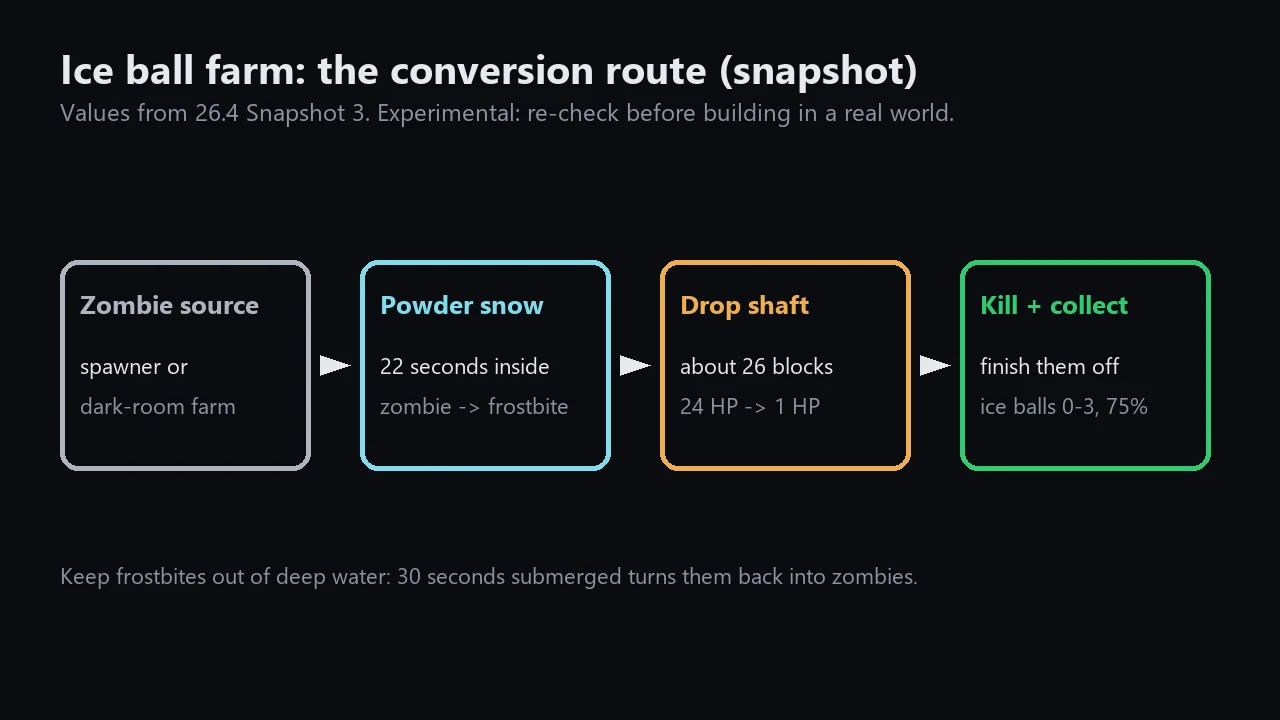 Diagram: SyntaxMine. The conversion route, with the Snapshot 3 values.
Rate0 to 3 ice balls per kill (75%)
XP levelRotten flesh, XP
Build timeSnapshot only
DifficultyAdvanced
Snapshot mechanics. Every number here is from 26.4 Snapshot 3 and can change before 26.4 releases. 26.3 had a mob change that lasted eight snapshots and was then reverted. Build in a copy of your world, and re-check each value against the latest snapshot notes before you commit to a design.
The numbers that matter
| Value (Java, Snapshot 3) |
Number |
| Ice ball drop |
0 to 3, 75% chance per kill |
| Rotten flesh drop |
0 to 2 |
| Frostbite health |
24 (a zombie has 20) |
| Frostbite armor |
2 |
| Zombie or husk to frostbite |
22 seconds inside powder snow, keeps its equipment |
| Frostbite back to zombie |
30 seconds underwater |
| Immune to |
Freezing, powder snow slowdown; stands on powder snow |
So on average a frostbite kill gives a little over one ice ball, and a single potion needs only one. Even a modest farm covers a brewing setup quickly. Arrows are where demand adds up, since each lingering potion makes eight Arrows of Freezing.
Two ways to get frostbites
Route 1: natural spawns
Frostbites spawn naturally in cold biomes. In Java their share of hostile spawns is:
- Ice caves: 9.62%, the best by a wide margin.
- Frozen peaks, ice spikes, frozen river, frozen ocean, deep frozen ocean: about 4.6% each.
- Snowy slopes, jagged peaks, snowy plains: about 1.9% each.
A dark-room mob farm built in one of these biomes will produce some frostbites alongside everything else. It is the simplest option, and also the least efficient: in the best biome, more than nine in ten spawns are something else. It is a good choice if you want a general mob farm and are happy to get ice balls as a side product.
Route 2: conversion from zombies
A zombie or husk becomes a frostbite after 22 seconds inside powder snow, keeping whatever it was wearing or holding. This is the same idea as zombies turning into drowned underwater, and it changes the economics completely: every zombie becomes a potential frostbite.
That means any reliable zombie source is the front half of an ice ball farm:
- a zombie spawner from a dungeon, or
- a dark-room farm in a biome where zombies are common.
Route the zombies into powder snow, wait out the conversion, and you have frostbites on demand. The rest of this guide is about that route.
How the conversion farm works
The design has four stages, the same shape as the diagram above.
1. Zombie source
A dungeon zombie spawner is the cleanest source: it produces only zombies, and they can be guided out by water like in any spawner farm. A spawner needs a player within 16 blocks to run, so your AFK spot has to be close.
2. Powder snow conversion chamber
Zombies need to spend 22 continuous seconds inside powder snow. Two facts shape this chamber:
- Powder snow freezes the zombies while they wait. A zombie in powder snow freezes and starts taking freezing damage, the same as any mob without leather armor. Over 22 seconds that is a real chunk of its 20 health, but well short of killing it, so the conversion should complete. Test this in your snapshot world: if zombies die before converting, shorten the wait between spawning and the snow, or give the spawner's zombies a less damaging path.
- Once converted, a frostbite can stand on top of powder snow. That is the opposite of a zombie, which sinks into it. The chamber has to account for converted frostbites rising out of the snow rather than staying inside it.
3. Drop shaft to 1 health
Frostbites have 24 health, not 20. Fall damage is roughly one point per block beyond the first three, and it ignores armor, so a drop of about 26 blocks leaves a frostbite on 1 health. A shaft sized for zombies (about 22 blocks) leaves frostbites with around 5 health. See the mob grinder guide for the full fall-damage maths.
4. Kill and collect
Finish the frostbites in a chamber they cannot attack you from, with hoppers underneath feeding a chest. Use Looting if you are killing them yourself; the snapshot notes do not yet document how Looting affects ice balls, so measure it.
Keep frostbites out of deep water. A frostbite that stays underwater for 30 seconds turns back into a zombie. Water streams that move mobs are fine as long as the mobs are not submerged that long, but a deep water elevator or a long underwater channel will undo your conversion.
Watch out for ice balls
Some frostbites throw ice balls, which deal up to 4 damage with knockback and can reach your AFK spot. Their melee attack applies Freezing for 3 seconds. Two simple protections:
- No line of sight from the conversion chamber or the kill chamber to where you stand.
- Wear leather armor at the farm. In Java, leather protects you from the freezing like it does in powder snow, even though the effect still applies.
What nobody knows yet
These are the questions that decide the final design. We will answer them by testing in-game, and we will update this guide when we have:
- Does the ice ball drop need a player kill? The rotten flesh drop does not, as with zombies, but Snapshot 3's notes do not say whether ice balls follow the same rule. If they do not need one, a fully automatic kill chamber works.
- How does Looting affect ice balls? Not documented yet.
- What exactly counts as "inside" powder snow for the 22 seconds: fully submerged, or just standing in it?
- How do converted frostbites leave the snow? They stand on powder snow, so whether they climb out on their own, and how to move them reliably to the drop shaft, needs testing.
- Will any of this survive to release? Conversion rules, drop chances and health are all snapshot values.
If you build one, we want to hear about it. A working design with real hourly numbers from a snapshot world is more useful than any theory on this page, and we will credit tested results when we update the guide.
Frequently asked questions
How do you get ice balls in Minecraft?
By killing frostbites. In 26.4 Snapshot 3 they drop 0 to 3 ice balls with a 75% chance. There is no other source.
How do you turn a zombie into a frostbite?
Keep it inside powder snow for 22 seconds. Husks convert the same way. The frostbite keeps the zombie's equipment.
Where do frostbites spawn naturally?
In cold biomes. Ice caves give the highest share (9.62% of hostile spawns), followed by frozen peaks, ice spikes, frozen rivers and frozen oceans at about 4.6% each.
How high should the drop be for frostbites?
About 26 blocks to bring a frostbite from 24 health to 1. A 22-block zombie drop leaves them with around 5 health.
Can I build an ice ball farm in a normal world now?
No. Frostbites and ice balls exist only in 26.4 snapshots on Java (and in the Bedrock preview behind an experiment). Test in a copy of a world.
The full Ice Caves drop, with every frostbite stat and the Java vs Bedrock differences, is in 26.4 Snapshot 3: Ice Caves on Java. The conversion idea is the same one behind drowned farms, and the trident farm guide covers the conversion trap that makes those useless for tridents.