Minecraft's Third Drop of 2026 is out now: Java Edition 26.3, officially named "Wilderness Bound," released 15 September 2026, alongside Bedrock 26.50. Before release, we loaded an early snapshot on a throwaway world and spent two days doing what we always do with a new version: finding the new biome the hard way, building with the new wood, breaking the new items on purpose, and looking for the mechanics that will matter after the novelty wears off. This is that field report, from the preview build.
The short version: this is a cozy, builder-first drop with one sneaky-good exploration item and one genuinely important change for technical players hiding in the decor list. Here is the long version.
Preview report, since-released update. Everything below comes from an early Java 26.3 snapshot and Bedrock Preview 26.40 experiment builds, tested before release. The update has since shipped as "Wilderness Bound" on 15 September 2026; for the confirmed, current-through-release feature rundown, see the 26.3 hub. This page stays as our hands-on field report from the preview.
Day one: finding a dappled forest
The dappled forest is the headline. It is an autumn-themed forest that generates near cold biomes, which in practice means you want to head toward taiga and snowy terrain and watch the tree line, not wander tropical coasts hoping. On our test world the first one showed up as a wall of warm colour against spruce: red, orange, and yellow canopies packed together, with sparse spruce trees poking through.
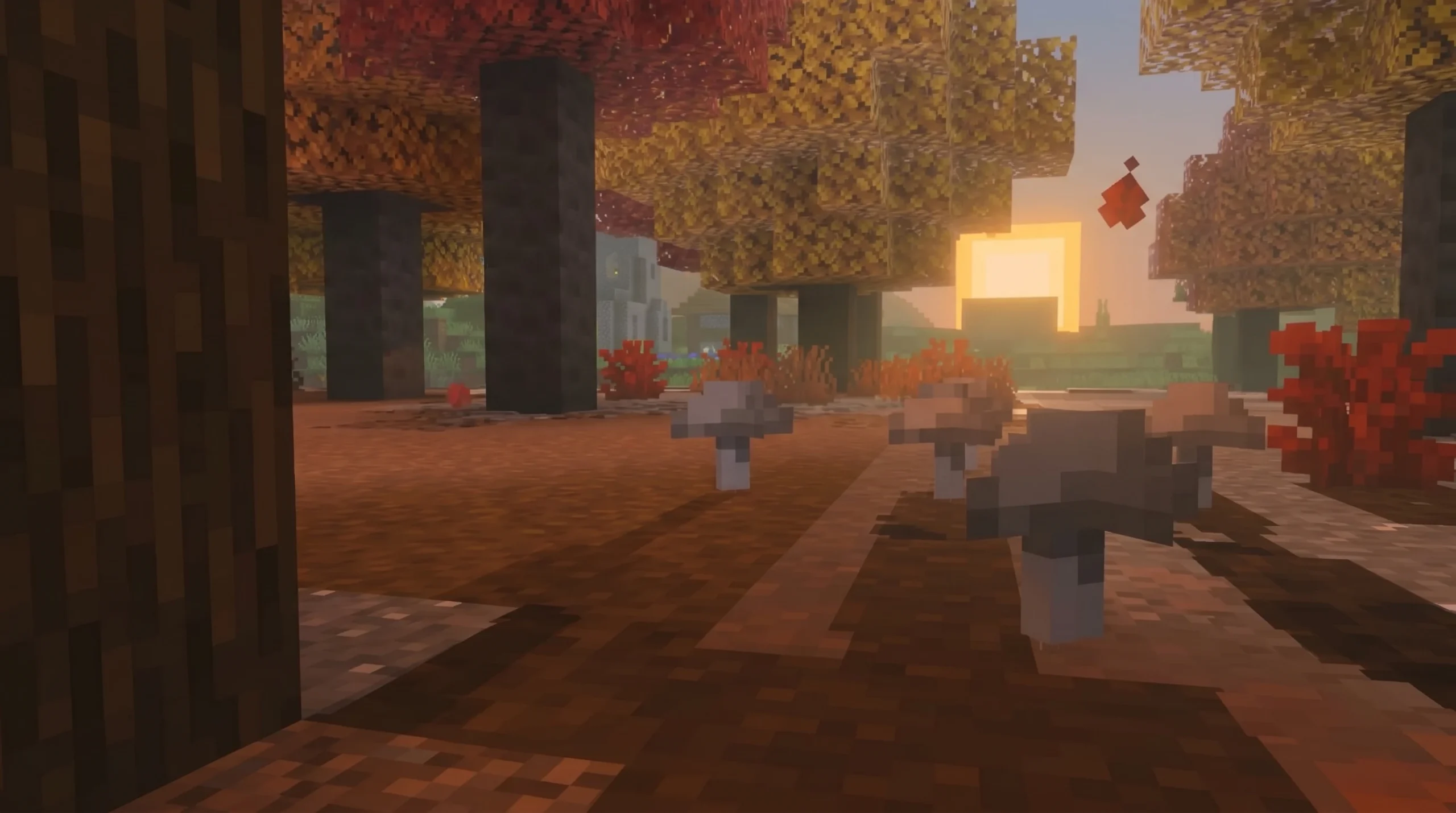
The dappled forest in the 26.3 preview. Image: Mojang Studios.
Up close, the biome sells the autumn theme with ground clutter, and the clutter is doing real work:
- Leaf litter covers the floor in drifts, the same block family that shipped with pale gardens, recoloured for autumn.
- Coarse dirt patches break up the grass, so the ground reads patchy and dry rather than lush.
- Red shrubs are a new low plant, and they keep their colour when you dig them up and replant them elsewhere, so the palette is exportable.
- Brown mushrooms and the new shelf mushrooms grow on and around the trees. Shelf mushrooms come in small and large variants and respond to bone meal.
- Falling leaf particles drift constantly, colour-matched to the canopy above you, at roughly the same rate as pale oak and cherry groves.
Mob spawning is deliberately quiet: rabbits, foxes, and the cold variants of farm animals. No new mob ships with this drop, and after two days we think that is the right call: the biome is scenery and resources, not a threat zone, and it reads like a place you settle rather than survive.
One practical note for base hunters: dappled forests border cold biomes, which means iron-rich mountain terrain and spruce mega-taiga logistics are usually one hill away. As starter-base biomes go, this one has better neighbours than cherry groves did.
Poplar: the first ORANGE wood, and it is a full set
Poplar is not a token log with one plank recipe. It ships complete on day one: logs, stripped logs, wood, stripped wood, planks, stairs, slabs, both sign types, buttons, pressure plates, doors, fences, fence gates, trapdoors, and shelves. Whatever build vocabulary you have, poplar speaks it immediately.
Two things stood out after a day of building with it:
The three-colour canopy is a world-generation roll, not a block state. Each poplar tree gets red, orange, or yellow leaves assigned at generation, and saplings you plant drop particles matching their own colour. If you want a specific shade for a tree farm or a garden, you are selecting saplings from the right parent trees, the way people already curate azalea and cherry looks.
The planks fill a real gap. Minecraft's wood palette has plenty of browns, a white (birch), a near-black (dark oak), a red (mangrove), and pinks (cherry, crimson). Poplar planks land in a muted grey-brown, close to taupe, a weathered neutral that builders used to fake with stripped logs and tuff. Paired with spruce trim it reads like a proper autumn cabin; paired with deepslate it is a surprisingly clean modern combo. We expect this wood to show up in every build server palette within a month of release.
The shelves deserve a mention: 26.1 added shelf blocks for every wood, poplar included, so the display-storage meta carries straight into the new set.
The decor batch: cushions, wool stairs, and a stealth mechanic nobody is talking about
The full block list, with what each new shape unlocks for building, is in wool and concrete stairs and slabs. The short version follows.
The cozy half of the drop is wool-flavoured:
- Wool stairs and slabs in all sixteen colours, crafted from wool exactly like their stone cousins.
- Cushions in all sixteen colours: three matching wool slabs craft one, they stack to 16, and they are rideable entities. You right-click and your character actually sits. Between cushions and the existing stair-sitting mods, vanilla furniture finally has a real answer.
Sitting on cushions is charming, and for one evening our test session degenerated into arranging a sixteen-colour cushion cinema. But the quietly important line in the change notes is this: wool stairs and slabs dampen vibrations, the same way full wool blocks do.
If you have built anything near a sculk sensor or a warden, you know why that matters. Until now, vibration-proofing a build meant full wool blocks: ugly, flammable rectangles you had to hide in walls and under carpets. With wool stairs and slabs, you can build actual architecture (steps, low tables, layered floors) that is sculk-silent by construction. Deep dark raiding kits and ancient city outposts just got a decor upgrade, and skulk-adjacent redstone (wireless setups that must NOT hear the player walking) gets shaped dampening instead of boxy dampening. This is the drop's biggest gift to technical players, and it is buried in the furniture paragraph.
Shelf mushrooms have their own toy physics: stand on a large one and it gives a slight bounce, bed-style, with its own squishy sound. After 26.2 shipped the bounciness attribute system and bouncing beds, we read this as Mojang steadily building out a soft-block physics family. Parkour map makers will find it first.
The straw bed: the best expedition item in years
On paper the straw bed sounds like a downgrade: a bed that does not set your spawn and destroys itself after one sleep. In practice, after taking a stack on a two-day mapping trip, we think it is the most immediately useful item in the drop.
The mechanics, as they stand in the preview:
- Crafted from 3 hay bales, yielding 4 straw beds. Hay is villager-farm cheap. The exchange rate is generous.
- Sleeping in one skips the night WITHOUT touching your spawn point. Your respawn stays wherever your real bed is.
- Single-use. The bed is destroyed after you wake up.
- Stacks to 16, so one inventory slot is four nights.
- No Nether or End use: the bed is destroyed there, but WITHOUT the explosion a regular bed produces. No more accidental bed bombs from muscle memory, and also no new portal-adjacent griefing tool.
- They generate in abandoned camps, so you will start finding them in world loot before you bother crafting any.
Why this matters: every long-distance player has overwritten their home spawn with a panic bed at 3am, then died somewhere stupid and woken up two hours from home. The straw bed is the fix. Elytra mapping runs, nether-adjacent overworld treks, early-game exploration before you have wool: sleep the night, keep your anchor. It also quietly removes the classic speedrunner-brain dilemma of "sleep here and ruin my spawn, or fight phantoms forever."
Our field verdict: bring four, come home with one, never think about phantoms again.
Abandoned camps: environmental storytelling with loot
The new structure is the abandoned camp, and the word doing the work is "abandoned": these are surface camps that generate adapted to their biome, in various states of decay. We found variants with stone windbreaks, collapsed tents of leaves, cobwebbed setups, one flooded into a pond, and one with a tiny overgrown crop farm still going.
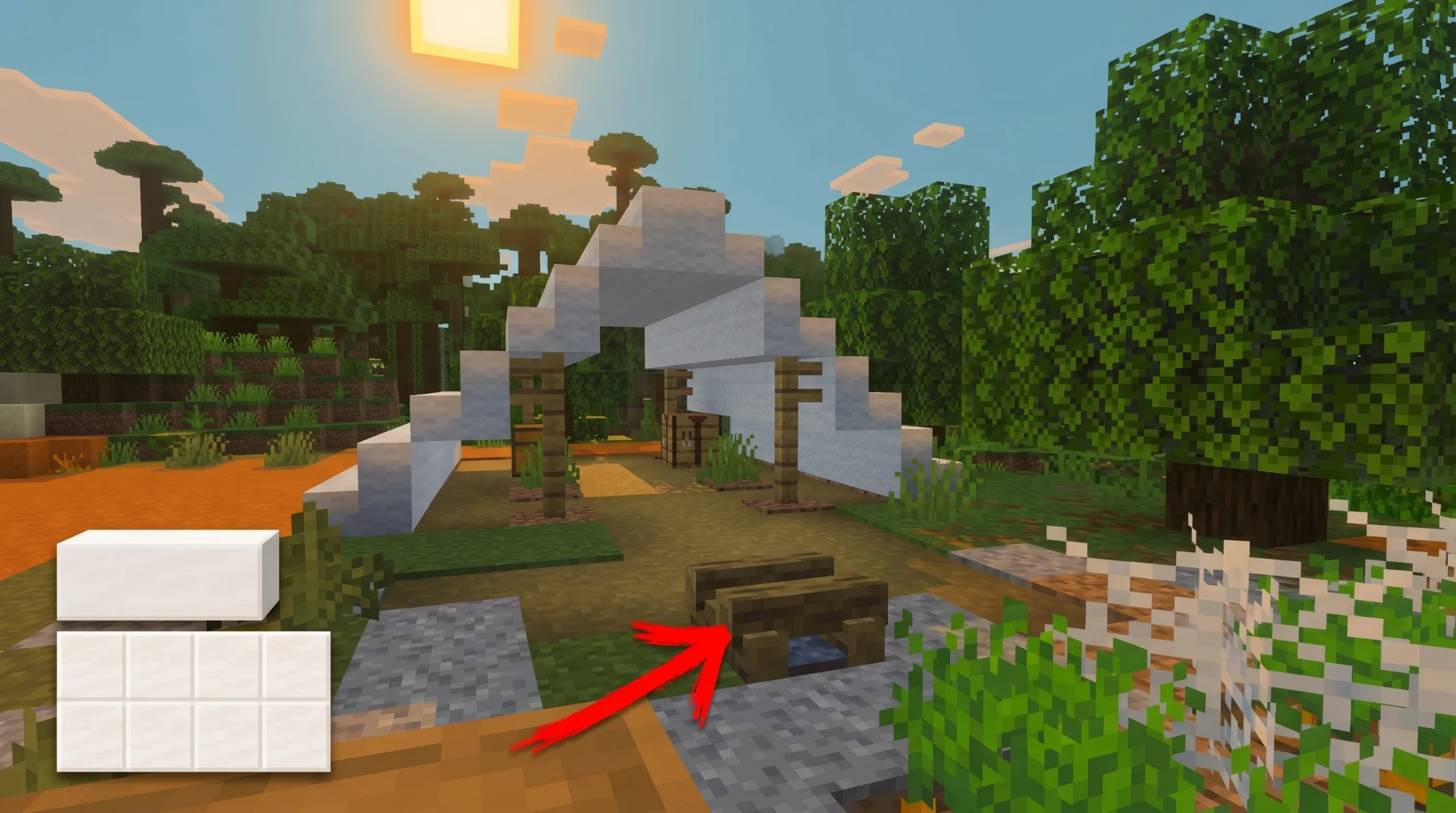
An abandoned camp in the 26.3 preview. Image: Mojang Studios.
Loot sits in chests and barrels, with a rare chance of an oxidized copper chest, which is the tell that somebody left a long time ago. Straw beds spawn here too, which is a neat loop: camps teach you the item exists, then you craft your own for your next trip.
They are not a treasure structure on the trial-chambers scale; they are a texture structure, the overworld equivalent of a shipwreck. Early game they are worth detouring for. Later they are set dressing, and honestly good set dressing: two of the ones we found told a better story than most custom maps.
What technical players should note
Beyond the wool dampening (see above, it is the headline for this audience), two days of poking produced this list:
- Bounce family grows. Shelf mushrooms bounce like beds. Combined with 26.2's
bounciness / air_drag_modifier / friction_modifier attributes and the bounce game event, soft-block physics is clearly a system Mojang is investing in. If you build with the 26.2 sulfur cube archetypes, the same instincts apply here.
- Colour-stable red shrubs mean a renewable, transplantable red ground-cover for map makers, no dye involved.
- Poplar leaf colour is fixed at generation, so leaf-colour-sorted tree farms are possible: separate your saplings by parent canopy and each farm lane stays one colour.
- No new mobs, no farm meta changes. Existing farm designs are untouched by this drop as far as the preview shows. The farm guides hub stays current.
- Pack format bumps ship with every drop; as with 26.2, mods need explicit 26.3 builds. Check your mod stack's Modrinth pages for 26.3 support before migrating a modded world; see what breaks in 26.3 for the current picture.
Like every biome since 1.18, the dappled forest picks its spots through climate noise (near-cold temperature band); our world generation explainer covers how those axes work if you want to predict where new biomes slot into existing worlds. As with sulfur caves, dappled forests will only generate in NEW chunks of an existing world.
What is rough right now
Honesty section, because previews deserve one:
- The dappled forest's spawn rate felt uneven in our testing: one world had three in render distance, another needed a long flight to find one. Preview generation tuning is normal at this stage; expect the balance to shift by release.
- Cushion seating is charming but finicky about placement surfaces in the current build.
- Bedrock and Java previews are not perfectly in sync feature-to-feature, which is standard for the drop cadence. If you compare editions, expect small differences until release.
- No new advancement list has stabilized yet.
None of this is alarming; all of it is why this page says "preview" at the top.
It's out now: play the real thing
Java 26.3 "Wilderness Bound" released 15 September 2026, keeping the roughly quarterly cadence: 26.1 in March, 26.2 "Chaos Cubed" in June. Update through the normal Minecraft Launcher rather than chasing a snapshot; there is no reason to play a preview build now that the stable release is out.
If you only have ten minutes with it, spend them like this: find a dappled forest at sunset for the particle show, sit on a cushion because you can, and craft a straw bed for your next real expedition. That is the drop in three acts.
FAQ
What is Minecraft's update after 26.2?
The Third Drop of 2026: Java Edition 26.3, "Wilderness Bound," and Bedrock 26.50, released 15 September 2026. Its headline features are the autumn dappled forest biome, poplar wood, cushions, wool stairs and slabs, single-use straw beds, and abandoned camp structures.
What is the dappled forest in Minecraft?
A new autumn-themed forest biome in 26.3, generating near cold biomes. It features poplar trees with red, orange, and yellow canopies, red shrubs, leaf litter, coarse dirt patches, shelf mushrooms, and spawns rabbits, foxes, and cold farm animal variants. No new mobs live there.
How do straw beds work?
You sleep through the night WITHOUT setting your spawn point, and the bed is destroyed after a single use. Three hay bales craft four straw beds, they stack to 16, and they generate in abandoned camps. They do not work in the Nether or the End: the bed is destroyed there without exploding.
Can you sit on cushions in Minecraft?
Yes. Cushions are rideable decorative entities: craft one from three wool slabs of the same colour (all 16 colours available), place it on a flat surface, and right-click to sit.
Do wool stairs and slabs block sculk sensors?
Yes: they dampen vibrations the same way full wool blocks do, which makes them the first decorative-shape wool for building sculk-silent structures. For deep dark bases and vibration-sensitive redstone this is the most important line in the drop.
Do dappled forests generate in old worlds?
Only in newly generated chunks, the same rule as every new biome. Travel beyond explored terrain after updating and look near cold biomes.
Sources & further reading:
Screenshots: Mojang Studios, from the official 26.3 preview materials.