Not every villager is worth your emeralds. A Master-level Farmer selling bread is not the same investment as a Librarian one trade away from Mending. This page is the full reference: every profession, the block that creates it, what it buys and sells at each tier, and the price mechanics that decide whether that Mending book costs 38 emeralds or 4.
RateVaries by profession
XP levelAny stage
Build time5-10 min per villager
DifficultyBeginner
This guide targets Minecraft 26.3 Java Edition. If you need a supply of villagers first, start with the villager breeder; once several professions are running, the trading hall guide covers housing them efficiently.
The trades that matter, by profession
Exact Java Edition numbers. Villagers level up as you trade with them, unlocking the next tier, so
the Master-tier rows are what you are working toward rather than what a fresh villager offers.
Librarian: the best villager in the game

 LibrarianLectern
Those are the filler trades. The reason you build a trading hall is the enchanted book slot,
which appears at every tier from Novice onward:
Enchanted book slotAvailable at every tier Any tier 5-64->
 1
1 The price formula is 2 + 3 x level to 6 + 13 x level emeralds, doubled for treasure
enchantments like Mending, so a Mending book lands around 10-38 emeralds before discounts. All
book trades are hard-capped at 64.
The part most players miss: a brand-new Novice librarian can offer Mending immediately. You do
not need to level one to Master and hope.
Cleric: turns mob-farm junk into emeralds

 ClericBrewing stand
32 rotten flesh for an emerald is the trade that matters. If you run any
mob farm you already have chests full of an item with
no other use. The Expert-tier ender pearls are the other prize: End preparation without hunting
endermen.
Farmer: the fastest first emeralds

 FarmerComposter
Novice 20->1
20->1 26->1
26->1 22->1
22->1 15->1
15->1 Novice1-> 6
6 Expert1-> 1
1 Read the melon line carefully: the farmer buys 4 melon blocks, not melon slices. A harvested
melon block drops 3 to 7 slices and it takes 9 slices to craft one back, so a melon farm is a worse
emerald source than it looks, and pumpkins (6 per emerald, one whole item per harvest, one tier
earlier) beat it outright. The melon and pumpkin farm guide
works the numbers through.
Before you have iron, gold, or a mob farm, you have crops. 15 beetroot per emerald is the best
rate on the board, and beetroot is trivial to automate. Pair with the
emerald farm guide for the scaled-up version.
The gear smiths
All three sell enchanted diamond equipment from Journeyman upward, which is the fastest route to a
working diamond kit if you have not built an enchanting setup. They also buy coal early, which
pairs with any mining surplus.

 ToolsmithSmithing table
Novice 15->1
15->1 
 ArmorerBlast furnace
Novice15->1 Journeyman1-> 1
1 
 FletcherFletching table
32 sticks for an emerald is nearly free once you have a
tree farm running, which makes the Fletcher a quiet
early-game income source most players overlook.
Every workstation, at a glance
Which block creates which profession, and whether the villager is worth housing.
| Workstation |
Profession |
Headline trade |
Worth it? |
| Lectern |
Librarian |
Enchanted books, incl. Mending |
Best in game |
| Brewing stand |
Cleric |
32 rotten flesh to 1 emerald |
Yes |
| Composter |
Farmer |
15 beetroot to 1 emerald |
Early game |
| Blast furnace |
Armorer |
Enchanted diamond armour |
Yes |
| Smithing table |
Toolsmith |
Enchanted diamond tools |
Yes |
 Grindstone Grindstone |
Weaponsmith |
Enchanted diamond axe and sword |
Yes |
| Fletching table |
Fletcher |
32 sticks to 1 emerald |
Situational |
 Cartography table Cartography table |
Cartographer |
Explorer maps |
Situational |
 Barrel Barrel |
Fisherman |
Enchanted fishing rod |
Skip |
 Loom Loom |
Shepherd |
Wool, beds, paintings |
Skip |
 Smoker Smoker |
Butcher |
Cooked meat |
Skip |
 Cauldron Cauldron |
Leatherworker |
Saddles, horse armour |
Skip |
 Stonecutter Stonecutter |
Mason |
Terracotta, quartz blocks |
Skip |
| - |
Nitwit |
Cannot be employed |
Breeding only |
Place the workstation, not the villager. An unemployed villager claims the nearest unclaimed job-site block in range. To pick a profession deliberately, put one villager in a closed room with exactly one workstation, and nothing else nearby to compete.
Re-rolling a librarian for a specific book
The book a librarian offers is decided when it takes the job, and you can re-roll it for free:
- Place a lectern next to an unemployed villager and check the offered book.
- Not the one you want? Break the lectern and place it again. The trade re-rolls.
- Repeat until the book appears.
This works only while the villager is still Novice and you have not traded with it yet -
a single trade locks the profession and its trade list permanently.
Worth re-rolling for: Mending, Efficiency V, Unbreaking III, Fortune III, Silk Touch,
Protection IV.
Making trades cheaper: the four levers
This is where most guides stop, and it is where the actual emeralds are saved. Four separate mechanics affect what you pay.
1. Curing a zombie villager (the big one)
Curing a zombie villager gives permanent major positive reputation with that villager, and the discount is dramatic: a Mending book that cost 38 emeralds can drop to a handful. The process:
- Find a zombie villager (or let a zombie infect one on Hard difficulty, where conversion is guaranteed).
- Trap it somewhere it cannot burn or reach you.
- Throw a Splash Potion of Weakness, then feed it a Golden Apple.
- Wait 3-5 minutes for the conversion.
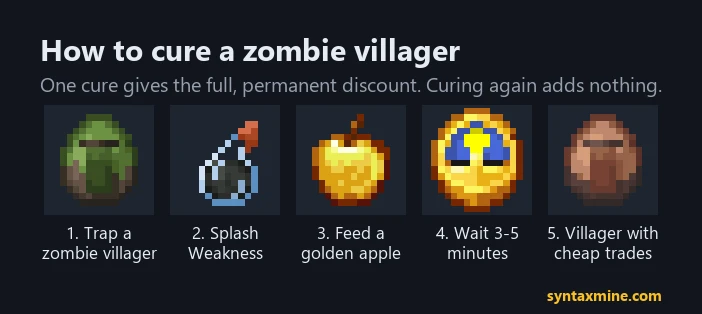 Image: SyntaxMine, made from Minecraft's own textures.
Curing the same villager a second time adds nothing: one cure is the whole discount, and it never wears off. Older guides tell you to re-infect and re-cure until a trade costs 1 potato per emerald; that worked until Java 1.20.2 and Bedrock 1.20.30, which removed the stacking. Today one cure takes about 6 items off a crop, stick or paper trade (20 wheat becomes 14, 6 pumpkins becomes 1), and up to about 25 emeralds off an enchanted book, which is where it really pays. Villagers standing nearby during the cure get a smaller discount too. This is the single most valuable trick in the game's economy, and it is why serious players build a curing station near their trading hall.
Cure BEFORE you trade, not after. Discounts apply to future trades. Trading first pushes the price up through demand, and the cure discount then applies to that inflated price.
2. Demand: prices rise the more you buy
Every individual trade tracks demand. Buy the same item repeatedly and its price climbs; the game recalculates twice a day when the villager restocks. Prices do not reset in place - the only way a trade returns to base cost is if it is replaced entirely when the villager levels to a new tier.
Practical rule: spread your purchases across several villagers of the same profession rather than draining one. Three Librarians at base price beat one Librarian at triple.
3. Hero of the Village
Winning a raid grants Hero of the Village, which cuts all villager prices by 30%, rising to 55% at level V. If you have a big shopping list, clear a raid first and buy everything while the effect lasts. It pairs naturally with a raid farm.
4. General reputation
Trading normally builds small positive reputation over time; hitting villagers or killing them tanks it and raises prices for everyone in that village. Do not punch villagers to move them - use boats or minecarts.
Restocking rules
- Villagers restock twice per day (in-game) by working at their job-site block.
- In Java Edition there is no bed requirement for restocking, only the workstation. Bedrock does require a bed.
- A villager must be able to reach its workstation. Trading halls that trap villagers away from their block silently stop restocking, which is the most common "my trades won't refresh" cause.
- Only two restocks happen without the villager gaining work XP, so a villager you never trade with will not keep cycling forever.
FAQ
What are the best villager trades in Minecraft 26.3?
Librarian for enchanted books (especially Mending), Cleric for turning rotten flesh into emeralds, and Toolsmith/Weaponsmith/Armorer for enchanted diamond gear without an enchanting table. Farmer is the best early-game emerald source.
How do I get a Mending villager?
Only Librarians sell Mending. Place a lectern by an unemployed villager, check the book, and if it is wrong, break and replace the lectern to re-roll. This works only while the villager is Novice and you have not traded with it. A cured zombie librarian offers Mending at a fraction of the normal price.
Which workstation gives which villager profession?
Lectern makes a Librarian, brewing stand a Cleric, composter a Farmer, blast furnace an Armorer, smithing table a Toolsmith, grindstone a Weaponsmith, fletching table a Fletcher, cartography table a Cartographer, barrel a Fisherman, loom a Shepherd, smoker a Butcher, cauldron a Leatherworker, and stonecutter a Mason.
Why did my villager's trade get so expensive?
Demand. Every purchase of that specific trade raises its price, recalculated when the villager restocks. It does not reset in place. Spread purchases across multiple villagers, or cure a zombie villager for a permanent discount.
Do villager trades reset?
Individual trade prices do not reset once inflated. The trade list itself changes when a villager levels up to a new tier, which can replace an overpriced trade with a fresh one at base cost.
How do I get infinite emeralds in Minecraft?
Pick a trade whose input you can farm renewably, then automate that input. The classic pairings are
a Farmer with a crop farm (15 beetroot or 20 wheat per emerald), a Cleric with a mob farm (32
rotten flesh per emerald), and a Fletcher with a tree farm (32 sticks per emerald). Villagers
restock twice a day, so income is capped per villager, not per hour: scale by adding villagers.
The emerald farm guide covers the full build.
How many trades can a villager do before restocking?
Each trade has its own stock, usually enough for a handful of uses, and villagers restock twice per
in-game day by working at their job site block. A villager that cannot reach its workstation never
restocks, which is the most common reason a trading hall stops producing.
Which villager professions should I skip?
Nitwit (cannot work at all), Mason, Butcher, Fisherman, and Leatherworker. Each sells things a basic farm or a cobblestone generator produces for free.
Sources & further reading:



 24->
24-> 1
1 4->
4-> 1
1 5->
5-> 4
4 2->
2-> 1
1 1
1 32->
32-> 2
2 3->
3-> 1
1 2->
2-> 1
1 4->
4-> 9->
9-> 1
1 22->
22-> 1
1 6->
6-> 4
4 4
4 4->
4-> 18
18 3
3 3
3 4->
4-> 1
1 1->
1-> 1
1 1
1 32->
32-> 16
16 26->
26-> 1
1 14->
14-> 1
1




Comments
Loading...