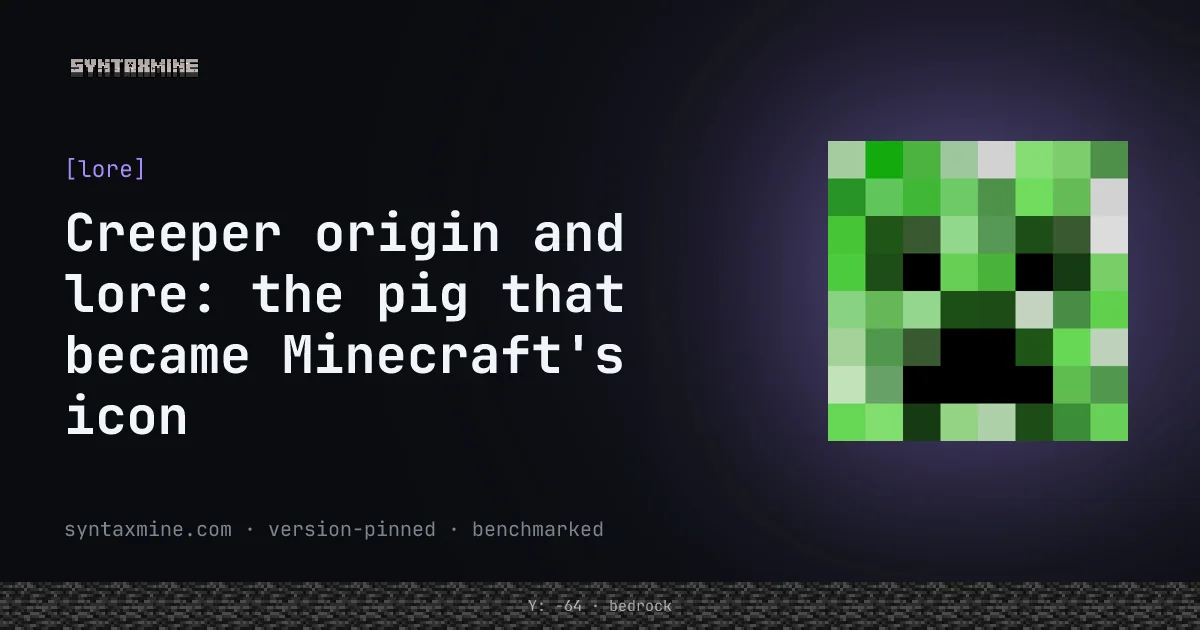
Ask a hundred people who have never touched Minecraft to draw one thing from the game, and a good number will draw the creeper: a tall green box with a frowning pixel face, seconds from a hiss and a bang. It is on t-shirts, plush toys, cake tins, and the game's own splash screens. It is the most recognizable thing Minecraft has ever produced.
It is also, uniquely among Minecraft's monsters, a documented accident. Most of this site's lore pieces work by reading mechanics as evidence, because the game itself withholds a real answer. The creeper is different in one specific way: we know exactly how the model came to exist, because the person who made it has said so, in public. That gives this article a spine most lore articles do not get. But the origin story only explains where the shape came from, not what a creeper is supposed to be inside Minecraft's world, and on that half the game is exactly as silent as it is about everything else. This is both halves: the documented accident, and the design choices that turned it into a monster with a personality nobody ever wrote down.
The pig that stood up
The creeper was not designed. It was a bug that Markus "Notch" Persson, Minecraft's original creator, decided to keep.
While building the game's early mob models, Notch was working on the pig. Pig models are long and low: a horizontal body on four short legs. Somewhere in the code that generates the model's proportions, Notch swapped two values, mixing up the height and the width (some retellings describe it as a rotation error instead). The result did not come out long and low. It came out tall, thin, and standing upright, roughly the height of a player.
Jens Bergensten, who later became Minecraft's lead creative developer, has recounted the story this way:
The story of the Creeper: it was supposed to be the pig, but Notch mixed the height and the width values, or the rotation of it, so it's standing up instead of lying horizontally.
Notch found the broken shape unsettling rather than useless, describing it as looking "extremely creepy," which is where the eventual name comes from. Instead of fixing the proportions, he kept the shape and repurposed it as a new hostile mob. A friend suggested giving it an explosion as its attack, and the creeper as players know it, silent, green, and built to detonate, took shape from there.
This account comes from Jens Bergensten and has been repeated by Notch himself in interviews over the years. It is one of the few Minecraft origin stories that is not reconstructed from mechanics or fan archaeology: the person who wrote the code has described the mistake directly. Treat the pig-to-creeper story as documented fact, not community theory.
The face, the texture, and the sound
Once the shape existed, the rest of the creeper's identity was built quickly around it.
The texture is famously sparse: a mottled green skin, widely read as a nod to camouflage even though creepers do nothing to hide in foliage, and a blocky face rendered in a handful of pixels that somehow still reads clearly as an expression, wide eyes and a downturned frown-mouth, at a resolution where most faces would just look like noise. Getting a recognizable, faintly ominous expression out of that few pixels is a large part of why the design still works two decades later.
The hiss every Minecraft player learns to fear is not a bespoke recording. It reuses the same sound file as primed TNT, just pitched down, a fitting shortcut: the creeper is, mechanically, a piece of TNT that walks up to you first.
The creeper shipped early, appearing during Minecraft's Classic development period in the version known as 0.24_SURVIVAL_TEST, released in September 2009, making it one of the game's original hostile mobs alongside the zombie and the skeleton. It has been in every version since, unchanged in its basic silhouette even as the game around it was rebuilt several times over.
What the documented history does not explain
Here is the line this article has to draw carefully, the same line our other lore pieces draw. The Notch anecdote tells you where the model came from: a broken pig, kept because it looked wrong in an interesting way. It does not tell you what a creeper is inside Minecraft's world. Those are different questions, and the game answers only the first one.
There is no book, no structure, no piece of environmental storytelling that explains why a mistake-shaped mob walks the Overworld hunting the player with an explosive payload. Zombies and skeletons at least gesture at familiar undead tropes. The creeper has no folklore behind it beyond the one Mojang built, and that gap is where every piece of community reading about creepers grows from.
The behaviors the game never explains
Set the origin story aside for a moment. Judged purely on its in-game behavior, the creeper is one of the stranger mobs Minecraft has, and none of the strangeness comes with an explanation attached.
It is silent until it isn't. A creeper gives almost no warning: no roar, no telegraph from a distance. It walks up quietly, and the only cue is the hiss that starts once it is already close enough to detonate. That silence is a deliberate design choice, not a technical accident like the pig-shape, and it is the biggest reason the creeper became the game's most feared early mob rather than just another reskinned zombie. Fear from ambush reads very differently from fear of a visible monster you can see coming.
It is afraid of cats and ocelots. This is exact mechanics, not a rumor: a creeper within roughly 6 blocks of a tamed cat or wild ocelot flees, faster than its normal walking speed, unless it has already started its detonation countdown. Nothing in the game explains why. Community explanations range from real-world folklore about cats warding off evil, to a gameplay nod that gives taming cats a passive-defense use. All of that is theory. The mechanic is fact; the reason is not stated.
It drops music discs, but only if a skeleton lands the kill. If a creeper is killed by a skeleton, stray, wither skeleton, bogged, or another skeleton-type mob, it drops a music disc at random, at a 100% rate. Kill it yourself with a sword, bow, or TNT, and it drops nothing extra; credit has to belong specifically to an arrow-user. Mojang has never explained the connection. The community reading that has stuck is that the disc is a strange trophy the creeper was already carrying, revealed only by a skeleton's arrow, but that is a reading, not confirmed lore.
Lightning creates a different, worse creeper. A regular creeper struck by lightning, or within about 4 blocks of a strike, becomes a charged creeper: visibly blue and crackling, with its explosion power doubled, from a blast radius of 3 to 6. A charged creeper's blast is also the only reliable way to make a killed mob, zombie, skeleton, wither skeleton, piglin, or another creeper, drop its own head, something that essentially never happens otherwise. Why electricity supercharges a creeper, or why that blast severs heads, is never explained.
It is the only mob that attacks by destroying the world itself. Every other hostile mob damages the player without touching the terrain. The creeper is the sole exception: its blast craters stone, wood, dirt, and most other blocks, permanently altering the map unless difficulty or game rules prevent block damage. That single property is why creepers get treated differently by nearly every builder in the game: a zombie nearby is an annoyance, a creeper nearby is a structural threat.
Everything in this section is either a confirmed mechanic (the cat radius, the skeleton-kill disc rule, the charged creeper blast, the terrain damage) or an explicitly labeled community reading of why that mechanic might exist. None of the "why" is confirmed by Mojang. Treat the mechanics as fact and the explanations as theory, the same distinction this site draws everywhere else in its lore coverage.
Reading the evidence the way the other lore pieces do
Our Enderman origin piece draws a hard line between what the game confirms and what fans have built from silence. The creeper gets the same treatment.
| What is confirmed |
What is theory |
| The model came from a coding mistake on the pig, per Jens Bergensten and Notch |
Why the mistake was kept rather than discarded beyond "it looked creepy" |
| Added in Classic 0.24_SURVIVAL_TEST, September 2009 |
What a creeper is meant to represent biologically or narratively |
| Flees cats/ocelots within roughly 6 blocks |
Why cats specifically frighten it |
| Drops a music disc only when a skeleton-type mob lands the kill, 100% of the time |
Why the disc exists at all, or why it needs a skeleton's arrow to surface |
| Lightning within 4 blocks creates a charged creeper, doubling blast radius |
Why electricity has that specific effect on a creeper's biology or design |
| It is the only mob whose attack destroys terrain |
Whether that makes it a natural hazard, a weapon, or something else entirely |
The most common community theory, for readers who want it anyway
The reading that comes up most often is that the creeper is not really a creature at all, but unstable, animate ore or a living hazard, similar in spirit to how TNT is inert until triggered. This would fit the reused TNT sound and the total absence of any creeper "society" the way zombies have villages and piglins have bastions. It does not explain the cat fear or the music disc rule at all, which is why it stays a theory: it fits some of the evidence and ignores the rest.
Why the accident stuck
Minecraft could easily have shipped with the pig-bug quietly fixed and never spoken of again. Instead, a coding error became the mob most responsible for the game's reputation as something genuinely tense to play, and later the closest thing Minecraft has to an official mascot, more recognizable in mainstream culture than the player character himself.
Part of that is a visual design that works far better than it should on such a small texture budget. Part of it is one reused sound file doing enormous work. But the biggest part is structural: the creeper is the one hostile mob whose failure state is not "you take some damage" but "your build is gone." That design decision, more than the accidental shape, is what turned a broken pig into the thing players still instinctively check for, twenty years after Notch decided not to delete it.
If creepers are wrecking your builds faster than you can farm them for gunpowder, our creeper farm guide covers a proper automatic setup, so the accident that ruins your walls can also stock your fireworks.
The same pattern runs through the rest of this site's lore: confirmed mechanics load-bearing enough to build theories on, and a developer team that never quite closes the loop, as the villagers and illagers piece shows. The music lore article covers the discs a creeper can drop. And the creeper's whole history sits as one entry in the complete Minecraft lore timeline, alongside every other mob and dimension this site has tried to separate into fact and reading.
The honest summary is short. A pig's code broke. Notch liked the result. A friend suggested it should explode. Everything since, the silence before the hiss, the fear of cats, the disc a skeleton's arrow reveals, the lightning that doubles the danger, is design layered on top of an accident, and the game has never once stepped outside its own mechanics to tell you what any of it means.
Frequently asked questions
Is it true that the creeper was a mistake?
Yes, and it is one of the few Minecraft origin stories fully documented rather than theorized. Jens Bergensten has described it directly: Notch was coding the pig model, mixed up its height and width values, and the result stood upright instead of lying flat. He found the broken shape unsettling and kept it, and a friend suggested adding an explosion.
Why do creepers explode?
Because that is the attack Mojang gave the accidental pig-shape once Notch decided to keep it as a monster. The game gives no in-world explanation for why it specifically detonates rather than attacking like other mobs; it is a design choice built on a documented coding accident, not something the lore addresses.
Why are creepers scared of cats?
A creeper within roughly 6 blocks of a tamed cat or wild ocelot flees at increased speed, unless it has already started exploding. This is confirmed mechanics. Mojang has never explained why; folklore about cats warding off evil and a gameplay nod for taming cats are both community theories, not confirmed lore.
Why do creepers drop music discs?
Only when killed by a skeleton, stray, wither skeleton, bogged, or another skeleton-type mob, at a 100% drop rate, one random disc from the pool. A kill by any other method drops nothing extra. The connection between skeleton kills and the disc is a confirmed rule with no stated in-world reason.
What is a charged creeper and how is it created?
A regular creeper struck by lightning, or within about 4 blocks of a strike, becomes a charged creeper: visibly blue and electric, with explosion power doubled, from a blast radius of 3 to 6. Charged creeper explosions are also the only reliable way to make most mobs drop their own head. The mechanic is confirmed; why electricity has this effect is never explained.
Is the creeper's origin the same kind of mystery as the Enderman or Herobrine?
No. The Enderman's inspiration and Herobrine's spread are reconstructed from interviews, forum archaeology, and mechanics. The creeper's origin as a broken pig model is a directly documented account from Jens Bergensten and Notch. What remains unexplained is not where the model came from, but what the creeper is meant to represent inside Minecraft's world.
Sources & further reading:



Comments
Loading...