For years copper was the ore you mined by accident and stored in a chest. Java 1.21.9 gave it a real role: copper tools and armor that sit between stone and iron, the copper golem, copper chests and lanterns, and later the copper spear. Here is what copper gear is worth, how oxidation works, and the best ways to spend a chest full of ingots.
Quick answers
- Is copper better than stone? Yes: same mining level, but faster, more durable and easier to enchant.
- Is copper better than iron? No. Iron mines faster, lasts longer and can mine gold, diamond and redstone. Copper cannot.
- Copper armor: 10 armor points for a full set, between leather (7) and gold (11).
- Stop oxidation: use a honeycomb on the block (waxing).
- Undo oxidation: scrape it with an axe, one stage per use, or let lightning hit it.
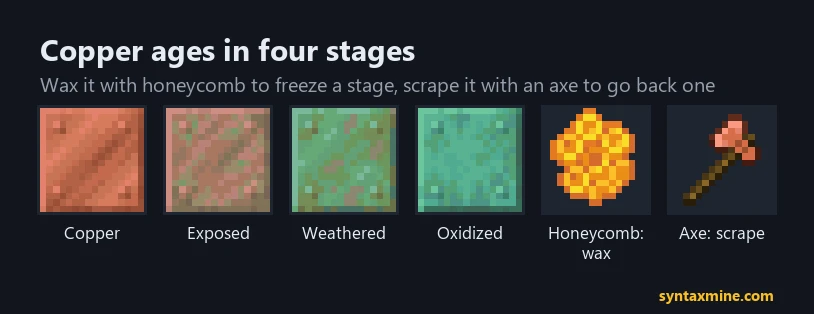 Image: SyntaxMine, made from Minecraft's own textures.
Copper tools use the same recipes as other tools, with copper ingots as the material. A copper pickaxe has mining level 1, the same as stone:
- Can mine: coal, copper, iron and lapis.
- Cannot mine: gold, redstone, diamond, emerald, obsidian or ancient debris. You still need iron for those.
| Pickaxe |
Mining level |
Durability |
| Stone |
1 |
131 |
| Copper |
1 |
190 |
| Iron |
2 |
250 |
Copper mines faster than stone and has better enchantability (13), so if you find copper before iron, a copper pickaxe is a worthwhile upgrade. Once you have iron, switch. The copper spear has its own quirks, covered in our spear guide.
Copper armor
| Piece |
Armor |
Durability |
| Helmet |
2 |
121 |
| Chestplate |
4 |
176 |
| Leggings |
3 |
165 |
| Boots |
1 |
143 |
| Full set |
10 |
|
For comparison, a full set of leather gives 7, gold 11, chainmail 12 and iron 15. Copper armor has no toughness and an enchantability of 8.
It is a fine first armor when copper is all you have: a full set costs 24 ingots, which a single big copper vein can cover. Damaged pieces can be repaired at an anvil with copper ingots, or by combining two damaged pieces in a crafting grid. Zombies and skeletons can now spawn wearing copper armor, so you will also pick some up from mob kills.
Where to find copper
Copper ore is common across the Overworld, most of all in the middle heights of the world, and dripstone caves are packed with large copper veins. One ore usually drops several raw copper, so a single cave trip yields stacks. Raw copper smelts into ingots, nine ingots make a block, and the newer copper nuggets come from smelting copper tools and armor.
How oxidation works
Copper blocks age through four stages: unoxidized, exposed, weathered and oxidized, turning from orange to blue-green. Oxidation only happens to unwaxed copper blocks, and it is slow and random:
- Each block has a small chance per random tick to start oxidizing. On average that is around 20 minutes before a block's first change.
- A block will not oxidize while any less-oxidized copper is within 4 blocks of it. That is why big copper builds age from the edges inward, and why clusters age much more slowly than single isolated blocks.
The stage matters for more than looks. A copper bulb gives light level 15 when new, 12 exposed, 8 weathered and 4 fully oxidized.
Stopping and reversing it
- Waxing: use a honeycomb on a copper block (or craft them together). Waxed copper never oxidizes, and looks exactly like unwaxed copper of the same stage, so keep track of what you have waxed.
- Scraping: right-click with an axe. The first use removes wax, each use after that removes one oxidation stage. The honeycomb is not returned.
- Lightning: a bolt hitting unwaxed copper strips all of its oxidation and can also clean nearby copper blocks. A lightning rod on a copper roof does this for you during thunderstorms.
Want a particular shade? Let the copper age to the stage you like, then wax it. That is how builders get a patchy, weathered roof that stays that way.
Honeycomb comes from beehives with a campfire underneath; our bee and honey farm guide makes it renewable.
The copper golem
Build one from a copper block with a carved pumpkin on top, and it carries items from copper chests into regular chests: a small, slow sorting system. The golem oxidizes over time too (about 7 hours of game time per stage when unwaxed), and a fully oxidized golem can eventually freeze into a statue. Wax it with a honeycomb to keep it moving. Our copper golem sorting guide shows a full setup.
The best things to spend copper on
- Lightning rods, to protect wooden builds from fire and keep copper roofs clean.
- A spyglass, for scouting (two copper and an amethyst shard).
- A brush for archaeology.
- Copper bulbs for redstone lighting that stays on without a signal.
- Copper tools and armor, as a stepping stone before iron.
- Copper golems and copper chests for simple item sorting.
- Decoration: cut copper, chiseled copper, copper grates, doors, trapdoors, bars, chains, lanterns and copper torches with their green flame.
Frequently asked questions
No. Copper tools are better than stone but worse than iron: they mine more slowly, break sooner and cannot mine gold, diamond, redstone or emerald ore.
How much armor does copper armor give?
A full set of copper armor gives 10 armor points: 2 for the helmet, 4 for the chestplate, 3 for the leggings and 1 for the boots. That is more than leather and a little less than gold.
How do you stop copper from oxidizing?
Use a honeycomb on the copper block to wax it. Waxed copper keeps its current colour forever. Scrape it with an axe if you ever want to remove the wax.
How do you make oxidized copper orange again?
Use an axe on it. Each use removes one stage of oxidation, so it takes three uses to get from fully oxidized back to new copper. Lightning striking the block also removes all oxidation at once.
Can a copper pickaxe mine diamonds?
No. A copper pickaxe has the same mining level as stone, so it can mine iron and copper but not diamond, gold or redstone ore. You need an iron pickaxe or better.






Comments
Loading...